

Updated: Sep 24
Peer Review Article | Open Access | Published 29th September 2026 | Submitted 19th June 2025
Development, Optimization and Evaluation of Ozenoxacin Nanoemulgel for the Treatment of Impetigo
Authors: Saniya Ansari, Ashish Gupta*, Gajanan Darwhekar - Acropolis Institute of Pharmaceutical Education and Research, Indore | EJPPS | 313, (2026) | Cite this article
Abstract
Background- Impetigo, a highly infectious superficial epidermal infection caused by Streptococci and Staphylococcus aureus, is commonly treated with topical antibacterial agents. Ozenoxacin is the drug of choice, a potent quinolone antibiotic, recently approved by (USFDA) in December 2017 with reported antibacterial activity against Impetigo. It is the preferred drug due to its strong antibacterial activity and lipophilic nature, which improves patient compliance.
Aim- This study aimed to develop and evaluate a nanoemulgel that combines nanotechnology and gel properties to improve drug penetration, provide targeted action and sustain therapeutic effects.
Method- Preliminary studies such as drug identification, solubility testing, and FTIR analysis were performed. Eucalyptus oil, Tween-80, and Span-80 were selected using the solubility equilibrium method. Smix ratios were optimized through water titration and pseudo-ternary diagrams. 13 Nanoemulgel formulation batches were prepared using a homogenization method and optimized via the Box-Behnken design model.
Result- The nanoemulgel formulations were characterised and evaluated for their physicochemical properties. Acceptable results were obtained from the optimized batch's evaluation parameters, globule size, PDI, and zetapotential. The optimized batch (F14) demonstrated 96.24% drug release over 12 hours in in-vitro studies using the Franz diffusion cell. The formulation exhibited a viscosity of 1430 cps at 100rpm, a pH range of 6.5–7.1, and excellent spreadability. Microbiological efficacy testing confirmed Ozenoxacin’s activity against Staphylococcus aureus. Stability analysis showed no significant changes in pH, viscosity, or drug content, confirming formulation stability. Compared to the marketed cream, the Nanoemulgel showed superior drug release, and the study successfully developed an optimized formulation that meets desired therapeutic and application requirements, ensuring satisfactory results.
Keywords: Ozenoxacin, Impetigo, Nanoemulgel, Box-Behnken design , Nanotechnology, Homogenization.
Abbreviations: OZN- Ozenoxacin USFDA- United States Food & Drug Administration, FTIR- Fourier transform infrared rays, UV- Ultra violet, Smix- Surfactant: cosurfactant weight ratio, GRAS- Generally recognized as safe, PDI- Polydispersity Index, ANOVA- Analysis of variance.
Introduction
Impetigo is an infection of the outermost layers of the epidermis that is usually caused by Gram-positive bacterial infections that generate patches of erythematous skin with a yellow crust, which are extremely contagious and easily spread. The lesions might cause pain or itching.1 Impetigo is a disease affecting children in hot, humid climates, mainly affecting the face but which can also appear on other body parts due to traumas such as abrasion, laceration, insect bite, or other injuries.2
Impetigo is a superficial skin infection that is particularly common in children and can be brought on by Staphylococcus aureus, group one beta-hemolytic streptococci, or both. It results in yellow-crusted, itchy plaques that are unpleasant or irritating, or bullous impetigo if blisters are present. Evidence-based research is crucial to inform treatment guidelines and reduce Impetigo's disease burden. Impetigo is caused by certain bacteria, including Staphylococcus aureus (80% of instances of non-bullous impetigo) and Staphylococcus group A (10% of bullous cases). These bacteria cause inflammation and infection in the outer layers of the child's skin after entering through cuts, rashes, scrapes, or insect bites. 3
Treatment
Topically applied antibacterial drugs, such as Ozenoxacin are frequently used to treat Impetigo. In December 2017, the USFDA authorized Ozenoxacin, a strong quinolone antibiotic with documented pharmacology, for the treatment of Impetigo. Since then, several countries throughout the world have authorized it. There is a growing need for topical formulations of Ozenoxacin with better action as it is approved in the US, Europe, and India. It has been demonstrated that Ozenoxacin is effective against a variety of pathogens, including Staphylococcus aureus and Streptococcus pyogenes. Due to its physical-chemical properties, Ozenoxacin enters bacterial cells quickly and initiates rapid contact with its sites of action, which produces strong anti-gram-positive bacterial activity. Ozenoxacin is a quinolone that inhibits DNA replication and kills bacteria rapidly. It has a lower MIC and a more rapid microbiological clearance than other quinolones. 4

Nanotechnology used for transdermal drug delivery system
Pharmaceutical formulations are commonly used to treat dermatological conditions such as Impetigo and atopic dermatitis. Nanotechnology has improved drug permeability over the past 20 years, enhancing solubilization, chemical stability, and focusing on the action site. This has increased medication efficacy, accessibility, and patient compliance in treating dermatological diseases. Nanotechnology offers promising drug delivery and targeting strategies, with nanoemulgel offering high therapeutic efficacy, kinetic stability, solubilization ability, skin permeability, controlled release, and drug targetability. A reservoir is a component of a nanoemulgel, which improves the rheological behaviour of nanoemulsions and decreases surface tension to promote stability and spreadability.
Nanoemulgel is a gel base formation that contains nanoemulsion. It is created by incorporating a nanoemulsion system into a gel matrix, which improves skin penetration.6,19 The drug reservoirs in this mixture of nanoemulgel affect the drug's release from inner phase to outer phase and beyond. Oil droplets are released from nanoemulgel. When skin is still intact, droplets in nanoemulsion-gel form penetrate the skin's dermal capillaries, transporting medication to desired locations. Its strong adhesion properties and high solubilization in oil phase increase the concentration gradient. This results in greater spread ability and lower stickiness, improving patient compliance compared to creams and ointments. Oil droplets in the gel's network permeate the stratum corneum, directly delivering drugs without transfer via the hydrophilic phase. 7
These drawbacks result in the need for repeated administration, increasing the risk of toxicity and reducing patient compliance. To address these issues, a nanoemulgel formulation of Ozenoxacin was selected for this study. Due to its nanosize, the nanoemulgel offers enhanced skin penetration and a larger interfacial area, improving drug absorption and stability. It is less sticky, easier to apply, and more acceptable to patients. The formulation also allows for reduced dosing frequency and improved therapeutic efficacy, especially for lipophilic drugs. The aim of this research is to develop a novel nanoemulgel drug delivery system for Ozenoxacin, evaluate its potential in treating Impetigo, and perform antimicrobial and comparative studies against the marketed cream formulation to demonstrate its superiority and enhanced clinical performance.

Materials And Methods
2.1 Materials
Ozenoxacin drug was received from Precise Pharma Limited, Mumbai; Ozenoxacin cream Noxa purchased from Indoco Remedies Ltd; Eucalyptus oil, Tween-80, Span-80, Carbopol 940, distilled water, Triethanolamine (TEA), methyl paraben, all chemicals purchased from Loba chemicals Pvt. Ltd. All chemical reagents used were analytical grade and applied without further purification.
Preliminary studies included drug characterization: Determination of wavelength UV spectroscopic study, by UV Spectrophotometer (Shimadzu 1800 Japan); Melting point determination by Remi Pvt. Ltd; Solubility determination of Ozenoxacin in methanol and phosphate buffer 7.4, were determined by the equilibrium solubility method; Drug-excipients compatibility study was carried out by FTIR. In the formulation of the nanoemulsion a high-speed Homogenizer (Remi Elektrotechnic Ltd) was used. The evaluation parameters were determined, such as pH by digital pH meter (Systonic India Private Ltd); Viscocity determined by a Brookfield viscometer (Ametek Instruments India Pvt Ltd) and in vitro drug permeation studies by a Franz diffusion cell (Orchid Scientific & Innovative Pvt.Ltd).
Methods
2.2 Screening of oils, surfactants, and co-surfactants based on solubility study
The ingredients selected for the nanoemulsion formulation were pharmaceutical-grade, non-irritating, and non-sensitizing to the skin. As a result, they fall under the category of generally recognized as safe (GRAS). In order to determine the best oil, surfactant, and co-surfactant, the solubility of Ozenoxacin in different oils was assessed. The equilibrium method was used to screen for Ozenoxacin solubility in the oils (Castor oil, Almond oil, Mustard oil, Eucalyptus oil, and Isopropyl myristate), surfactants (Tween 80, Tween 20, and PEG 400), and co-surfactants (Span 80, Span 20, and propylene glycol). Sufficient amount of drug was added in 5ml of the selected oil, surfactant, and cosurfactant in stoppered vials and the mixture stirred continuously for 30 minutes and then kept for 24 hours, to achieve equilibrium. Equilibrated samples were then centrifuged for 20 minutes at 5,000 rpm. After being separated, filtered, and appropriately diluted with phosphate buffer solution, the supernatant's solubility was determined by UV Spectrophotometer analysis at 250 nm. ⁹⁻¹⁰
2.3 Selection of optimum Smix ratio
The aquous titration method was employed to construct ternary phase diagrams that defined the extent and nature of the nano emulsion region. the solubility investigations led to the selection of span-80 as a co-surfactant, Tween 80 as a surfactant, and eucalyptus oil as the oil phase. (a) 1:1 and (b) 1:2 Smix was made. These mixes were then combined with oil to achieve the desired weight ratio, which was 9:1 to 1:9 (w/w). Before titrating with water, each oil and Smix mixture was vortexed to create a uniform mixture. While being magnetically swirled at room temperature, these combinations were titrated using distilled water drop-by-drop. The mixture was displayed for clarity during the titration process following each addition. the aqueous phase was added in drop wise until the solution turned clear or transparent at the endpoint of the titration. the volume of water required to make the mixture turbid or clear was noted.¹¹
2.4 Construction of pseudo ternary phase diagram
Ternary phase diagrams were constructed to study the nanoemulsion region. Pseudo ternary phase diagrams were constructed by titrating the blend of oil and surfactant: co-surfactant mixture (Smix) without drug by incremental amounts of water. Surfactant and cosurfactant mixtures were made in various weight ratios, such as 1:1, 1:2. Each Smix was combined with oil in a different weight ratio (oil: Smix) of 1:9, 2:8, 3:7, 4:6, 5:5, 6:4, 7:3, 8:2, and 9:1. At room temperature, water was added drop by drop while being magnetically stirred, and each addition was checked for appearance. Water, Smix, and oil are taken on the three axes. In order to identify the limits of the nanoemulsion region in the phase diagram region that displayed the maximum and minimum levels of mixtures for the formulation of NE, these oil, surfactant, and cosurfactant values were employed. The percentages of the components were calculated and plotted on the pseudo-ternary phase diagram. The figure in which oil, Smix and water combinations show greater nanoemulsion areas are used for further study. Pseudoternary diagrams were constructed using Ternaryplot.com.¹²

The pseudo ternary phase diagrams of eucalyptus oil with Tween 80 and Span 80 at various ratios, i.e. 1:1 and 1:2, are represented in Figure 3. The clear and stable nanoemulsion area is represented by the coloured portion in the phase diagram, while the non-coloured portion represents the existence of a turbid and conventional emulsion. The phase diagram with the Smix ratio of 1:2 showed the highest area of emulsification and was therefore selected for further studies.
2.5 Preparation of Ozenoxacin nanoemulsion by homogenization method
For formulating nanoemulsion, the oil phase (Span 80 in eucalyptus oil) the aquous co-surfactant along with 200 mg of Ozenoxacin was dissolved in oil which gives the oil phase. for preparation of the aqueous phase (Tween 80 in distilled water) surfactant was dissolved in distilled water. Both the oily and aqueous phases were heated at 60-70°C separately then the phases were combined with continuous stirring. and the emulsion was homogenized using a high energy homogenizer for 30 minutes at 4000-5000rpm before cooling to room temperature. therefore, nanoemulsion processing using high pressure homogenizer required several homogenization cycles at high pressure in order to achieve nanoemulsion in nanometre size.13,14

Preparation of nanoemulgel
For the preparation of gel base, Carbopol 940 was selected. the Carbopol was soaked in water for 24 hours. Triethanolamine was used to adjust the pH 7 of Carbopol gel by adding few drops. The nanoemulsion was then incorporated in several formulations of gel with continuous stirring. 14
Transformation of nanoemulsion into nanoemulgel
Nanoemulgel is produced when the optimized nanoemulsion is incorporated with a suitable gel base, such as Carbopol-940. 23
2.6 Optimization of Nanoemulgel using Box-Behnken design
The Box-Behnken design was used for the optimization employing Design Expert® software (Version 13, Stat-Ease), for the formulation and evaluation of nanoemulgel of Ozenoxacin. Concentrations of oil (X1), Smix (surfactant/cosurfactant) (X2), and carbopol 940 (X3) were selected as independent variables whereas In-vitro % drug release (Y1) and viscosity (Y2) were selected as dependent, factors and their levels are shown in table 1. 23
Table 1. Selected factors and their levels
S. No | Independent variables | Levels | |
Low | High | ||
1. | X1: Concentration of oil (grams) | 4 | 6 |
2. | X2: Concentration of Smix -surfactant/cosurfactant (grams) | 3 | 7 |
3. | X3: Concentration of carbopol 940(grams) | 0.135 | 0.15 |
Table 1 shows the independent variables and by taking above 3 factors with their different concentration (levels) 13 batches were formulated and evaluated on the basis of response which is given in table-3 below.24
2.5 Characterization of nanoemulsion
1. Physical appearance - The characteristics of nanoemulsion were observed based on physical appearance and consistency by visual observation.16
2. Dilution test - A dilution test was carried out by addition of water or oil used in the formulation to determine the type of nanoemulsion. If water was easily dispersed in the continuous phase, the nanoemulsion was defined as oil-in-water and if oil was dispersible in the continuous phase, the nanoemulsion was defined as water-in-oil.17
3. Dye test - Amaranth solution, a water-soluble dye, was used to determine the type of emulsion. It was found that when amaranth dye was added to an emulsion, the continuous phase was coloured and the disperse phase was colourless, indicating that the nanoemulsion was an o/w emulsion.18
4. Entrapment efficiency - The entrapment efficiency of Ozenoxacin in the nanoemulsion formulation was determined by ultracentrifugation. The nanoemulsion samples were vortexed for two cycles of 5 min each, with a 2 min rest interval between the cycles. Subsequently, 1.5 mL of the nanoemulsion formulation was transferred to a centrifuge tube and centrifuged at 5,000 rpm for 30 min. The supernatant was carefully separated, suitably diluted with distilled water, and analyzed spectrophotometrically at 250 nm to determine the concentration of free Ozenoxacin.19
5. Entrapment efficiency

6. Percentage transmittance - The homogeneous formulations were tested against water for transmittance at 630 nm and analysed for percent transmittance using a UV-Vis spectrophotometer. Distilled water was utilized to dilute each nanoemulsion formulation fifty times. Then, three duplicates were carried out for each nanoemulsion and the transmittance percentage was measured at 650 nm against distilled water as a blank solution.20
7. Globule size determination - The globule size was measured using the widely employed dynamic light scattering (DLS) technique with a Nanotrac Wave instrument. Prior to analysis, the formulations were diluted appropriately with deionized distilled water. Light scattering was measured at 90ºangle at room temperature 25±2ºC. then the identification of globule size was recorded by Nanotrac software. Based on intensity, volume, and bimodal distribution, the administration of drugs requires small droplet sizes because oil droplets tend to fuse with the skin, providing a channel for the drug to be delivered.20
8. Polydispersity index - The PDI was measured using a Nanotrac wave instrument, the polydispersity index (PDI) and mean droplet size were calculated, assuming spherical particles. PDI is a measure of globule homogenicity, the closer to zero the PDI value the more homogenous are the particles. PDI values of nanoemulsion formulation were less than 0.5, which indicated the uniformity of droplet size distribution and affirmed their homogeneity.21
9. Zetapotential - The surface charge (zeta potential) of the formulations was analysed using a Nanotrac wave instrument at room temperature. The zeta potential (ZP), which provides information on the repulsive forces between particles is measured to describe the surface charge of Nanoemulsion particles.22
2.8 Characterization of nanoemulgel
1. Physical appearance
Nanoemulgel was tested for physical appearance and consistency by visual appearance after the nanoemulgel was applied as a thin layer on a slide.25
2. Measurement of pH
A digital pH meter was used to identify the pH of the nanoemulgel. To produce a 1% aqueous solution of the prepared nanoemulgel in 100ml of distilled water, 1g of NEG was dissolved. the mixture was then agitated until it formed a homogenous solution and then left for an hour. The measurements of pH of each formulation were done in triplicates and mean values were calculated.12
3. Viscocity measurement
The viscosity of nanoemulgel was determined using spindle number 92 on a Brookfield viscometer. Formulations were added to a beaker covered with a thermostatic jacket to determine their viscosity. The spindle was allowed to move freely in the formulation process. The procedure was performed in triplicate, and the mean values were recorded.11
4. Spreadability study
The spreadability of the gel composition was evaluated on two glass slides of the same length. To create a uniform layer of nanoemulgel and release the air between the slides, 1g of gel was applied to one glass slide, the other slide was placed on top of it, and weights (20g) were placed on it for a few minutes. The time it took for the glass slide to separate from the first glass slide was measured in seconds. The time it takes for the top slide to move 5 cm in seconds should be recorded. A shorter period indicates better spreadability. Spreadability of nanoemulgel was calculated by using the formula,
S= M×L/T
Where
S = spreadability,
M = Weight tied to the upper slide,
L = Length moved by glass slides,
T = Time in seconds in order to separate the slides completely.25
5. Drug content
The drug content of nanoemulgel was determined by dissolving 1 gm of the formulation equivalent to 10 mg of ozenoxacin in 100 ml phosphate buffer pH 7.4 with constant stirring using a magnetic stirrer. From the above solution 1 ml was withdrawn and diluted up to 10 ml with phosphate buffer. The above solution was kept for sonication for 30 min to dissolve the drug completely, filtered and observed with a UV-VIS spectrophotometer at 250nm. The measurements were made in triplicate. 22
6. In vitro % drug release
Franz diffusion cells were utilized in an in vitro drug release study. The donor compartment's cellophane membrane came into touch with 1.0g of the prepared nanoemulgel sample. An outer jacket kept the receptor cell at 37±0.5°C while 42ml of phosphate buffer (PBS) with a pH of 7.4 was mixed at 100rpm using a magnetic stirrer. Sink conditions were maintained throughout the test by regularly removing 1ml of sample from the receptor compartment and replacing it immediately with an equivalent volume of fresh dissolution medium at the same temperature. After proper dilutions, the aliquots of 1ml were collected at time interval of 1 to 12 hours. Collected samples were analysed in UV-VIS spectrophotometer at 250nm. 9
7. Stability studies
For the nanoemulgel stability study, different temperature conditions were applied: 4°C (refrigerator), room temperature (25°C±2℃), and 40°C±2℃. The formulation was exposed to different conditions of temperature as well as relative humidity 75 %RH±5RH for a specific time period of 2 months. After one month the samples were analysed for their appearance, pH measurement, rheological characteristics, spreadability analysis, and drug content. 14,27
2.9 Comparative study of nanoemulgel with marketed formulation
1. In vitro % drug release
Comparative study of drug release for nanoemulgel and marketed cream at time interval of 12 hours was performed using Franz diffusion. The receptor cell was kept at 37±0.5°C by an outside jacket and 42 ml of phosphate buffer (PBS) with a pH of 7.4 was agitated at 100 rpm using a magnetic stirrer. The donor compartment's cellophane membrane was in contact with 1.0 g of the prepared nanoemulgel sample. nanoemulgel and marketed formulation was applied to the surface of the cellophane membrane respectively. To solubilize the drug, the cellophane membrane was placed in the centre of the donor and receptor chambers, which were charged with phosphate buffer (pH 7.4). A magnetic stirrer was used to agitate the receptor chamber. Following the proper dilutions, the samples (1.01 ml aliquots) were collected at appropriate intervals of 1 to 12 hours and analysed using a UV VIS spectrophotometer at a suitable wavelength. To determine the overall amount of drug released at an appropriate time period, cumulative corrections were conducted. The cumulative amount of drug release from the cellophane membrane was determined as a function of time. 9,14
2. In vitro antibacterial activity
The cup plate method was used to determine the microbiological efficacy of Ozenoxacin in the optimized Ozenoxacin-NEG, Ozenoxacin cream and Placebo NEG against Staphylococcus aureus. Each sterile petri dish was filled with 10–15 mls. of nutrient agar media, which was then left to set at room temperature. Using a sterile cotton swab, the bacterial culture was inoculated into the agar medium's surface. A sample containing 0.1% w/w Ozenoxacin formulation was quantitatively applied to these plates. Both the positive and negative control plates were kept in order to verify the experiment.
The Petri dishes were incubated at 37 °C for 24 h under aerobic conditions. Following incubation, the antibacterial activity of the formulations was evaluated by measuring the diameter of the zones of inhibition using a measuring scale, and the mean values were recorded for all test samples.23,24
3. Results and Discussion
3.1 Drug characterization
UV spectroscopy- Preformulation studies included drug characterization and determination of the analytical wavelength by UV spectroscopic analysis using a UV–Visible Spectrophotometer (Shimadzu UV-1800, Japan). Methanol was used as the solvent and blank for baseline correction. A 50 μg/mL solution of ozenoxacin was scanned over the wavelength range of 200–400 nm. The UV spectrum exhibited two absorption peaks at 250 nm and 302 nm, with maximum absorbance observed at 250 nm; therefore, 250 nm was selected as the analytical wavelength (λmax) for further studies. The observed λmax was consistent with the reported value. The UV absorption spectrum of ozenoxacin is shown in Figure 1.28
FTIR- The FTIR spectrum of the pure drug was recorded using a Bruker FTIR spectrophotometer. The sample was scanned over the range of 4000–500 cm⁻¹, and the obtained peaks were compared with standard IR tables to identify the characteristic functional groups present in the drug.

FTIR- The FTIR spectrum of the pure drug was recorded using a Bruker FTIR spectrophotometer. The sample was scanned over the range of 4000–500cm⁻¹, and the obtained peaks were compared with standard IR tables to identify the characteristic functional groups present in the drug.

Table 2. Interpretation of FTIR spectra of Ozenoxacin
Group | Standard frequency (cm-1) | Observation frequency (cm-1) |
Aromatic Amine | 1335-1250 | 1322.8549 |
Aminopyridine | 3500-3350 | 3416.6166 |
Cyclopropane | 950-770 | 916.3166 |
C-H bending | 900-680 | 804.8247 |
C=N group | 1350-1200 | 1308.1328 |
Quinoline | 850-750 | 804.8247 |
N-H group | 3500-3200 | 3416.6166 |
Evaluation parameters of nanoemulsion
1. Physical appearance
The characteristics of the nanoemulsion were observed based on physical appereance and concistency by visual observation.
2. Dilution test
The dilution test was carried out by addition of water used in the formulation to determine the type of emulsion. During this test water was used to dilute the emulsion and the water distributed uniformly and the emulsion remained stable so the nanoemulsion was defined as o/w emulsion.
3. Dye test
Amaranth solution, a water-soluble dye, was used to determine the type of emulsion. It was found that when amaranth dye was added to an emulsion, the continuous phase was coloured and the disperse phase was colourless, indicating that the nanoemulsion was an o/w emulsion.
4. Entrapment efficiency
Entrapment efficiency of Nanoemulsion was found to be 85.54% in optimized nanoemulsion formulation which indicated it to be a good formulation.
5. Transmittence percentage
Percentage transmittance of optimized nanoemulsion was 94.20% measured by a UV-visible spectrophotometer.
3.3 Optimization of nanoemulgel
A Box–Behnken design was employed to optimize the formulation variables as required by response surface methodology. The 3D response surface and contour plots generated using Design-Expert® 13 software are shown in Figures 7 and 8, and the responses are presented in Table 3. Based on pseudo-ternary phase diagrams, the Smix ratio was fixed at 1:2. The oil phase and Smix were selected as independent variables, while gelling agent viscosity was taken as another independent variable, and their effects on the dependent variables were evaluated.23
Table 3. Observed response in Box-Behnken design for nanoemulgel of Ozenoxacin
Formulation code | Independent variables | Dependent variables | |||
Oil (gm) | Smix (gm) | Carbopol 940 (gm) | In-vitro % drug release (in hours) | Viscosity (cps) | |
F1 | 5 | 3 | 0.15 | 92.62 | 984 |
F2 | 6 | 3 | 0.1425 | 87.36 | 1280 |
F3 | 4 | 5 | 0.135 | 93.72 | 1036 |
F4 | 4 | 3 | 0.1425 | 85.51 | 1205 |
F5 | 5 | 5 | 0.1425 | 95.32 | 1350 |
F6 | 5 | 7 | 0.135 | 94.31 | 1142 |
F7 | 4 | 7 | 0.1425 | 90.03 | 1270 |
F8 | 6 | 7 | 0.135 | 95.47 | 1208 |
F9 | 5 | 7 | 0.15 | 92.48 | 900 |
F10 | 6 | 5 | 0.135 | 91.88 | 1100 |
F11 | 5 | 3 | 0.15 | 89.06 | 1344 |
F12 | 4 | 5 | 0.1425 | 97.02 | 1450 |
F13 | 6 | 5 | 0.15 | 93.25 | 1009 |
Optimized formula by Box-Bhenken
Based on the responses of the 13 formulations (i.e., in vitro drug release and viscosity), the data were input into Design-Expert® software, which suggested an optimized formulation. The intimated optimized formula was then prepared with the concentrations as shown in Table 4 and was evaluated.
Table 4. Optimized formula table for the preparation of nanoemulgel
Factor 1
A: Oil (gm) | Factor 2
B: Smix (gm) | Factor 3
C: Carbopol (gm) |
4.909 | 5.507 | 0.144 |
Table 5- Responses of other evaluation parameters of optimized batch
Responses | Result of Responses Expected | Results of Responses found |
Viscosity (Cps) | 1442cps | 1430 cps |
In Vitro % Drug release | 97.81% | 96.24% |
3.4 Response curve obtained for both responses
[A] Effect of X1, X2 and X3 on Y1
The 3D surface plot generated by the software (Figure-8) depicts the effect of factors X1, X2, and X3 on the response Y1, as expressed by the following equation:In vitro % drug release =+95.32+0.0450X1+1.35X2+0.8150X30.7300X1X2+2.23X1X3-0.2550X2X3+4.9X1²-1.56 X3²
The in vitro % drug release (Y1) showed significant increase when the concentration of oil (X1) and concentration of Smix (X2) individually as well as in combination increase and concentration of (X2) and (X3) show less effect on the (Y1), i.e. in vitro % drug release as per the graph shown below in Figure 7.


[B] Effect of X1, X2 and X3 on Y2
The effect of factors X1, X2 and X3 on Y2 was shown by the equation given below:
Viscosity= +1450.00+26.50A-12.38B-109.88C-34.25AB-104.25AC+81.00BC-140.50A2-68.75B22.37.25C2
The 3D Surface plot was plotted by software on the basis of the given equation. (Y2) Viscosity showed significant increase when the concentration of Smix (X2) and concentration of carbopol (X3)
individually as well as in combination increased, and when the concentration of (X1) and (X3) decreased, the viscosity (Y2) also decreased, as per the graph shown below in Figure 10.


The response, in vitro % drug release (Y1) and viscosity (Y2) were found in the range from 85.51 to 96.24% and 900 to 1450cps respectively. In order to evaluate the quantitative impacts of the various combinations of factor level on the in vitro % drug release and viscosity, the response models were calculated using Design Expert software by applying coded values of factor levels the model described could be represented by full model equations:
The responses obtained from all the prepared formulations were fitted to various models using Design-Expert® software, and the quadratic model was identified as the best-fitting model.
Data analysis
The value of R2 was found to be 0.9644 and 0.9676 for in vitro % drug release and viscosity respectively, indicating good fit. In order to investigate the significance and fitness of the model, an ANOVA also showed the effect of individual parameters and interaction of variable on the nanoemulsion of topical gel. The high value of adjusted R2 signifies a good explanation of the variability by the selected mode.
The model F-value for in-vitro % drug release factor and viscosity factor was found to be 9.03 and 9.96 respectively implies that the model was significant. The p value (or Prob˃ F) was the probability of achieving the F-value. The values less than 0.05 indicate statistically significant difference between the means.
3.4 Evaluation parameters of nanoemulgel
1. Physical examination
The prepared nanoemulgel was inspected for colour, consistency and homogeneity. The formulation was found to be elegant in appearance and exhibited good consistency.

2. Measurement of pH
All formulations exhibited pH values between 6.5 to 7.4, which is consistent with the pH of the skin and indicates compatibility with the skin. This helps to prevent skin irritation after application.The pH of nanoemulgel formulations is shown in Table 6 below.
3. Viscosity measurement
The value of viscosity ranges from 900 to 1450cps.
The optimized formulation (F14), prepared with 0.144 g of gelling agent, exhibited a viscosity of 1430 cP. The viscosity values of the nanoemulgel formulations from batches F1 to F13 are presented in Table 6.
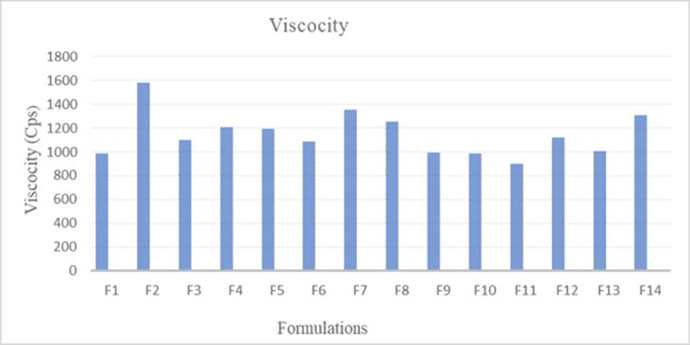
4. Percentage drug content
The observed range of percentage drug content for all the formulation was from 89.34% to 97.57% as shown in Table 6 below.

5. Spreadability study
The spreadability study for all the formulations was from 12.3 to 19.02 gm.cm/sec as shown in Table 6 below
Table 6. pH, viscosity, % drug content and spreadability study determination of Nanoemulgel
Formulations | pH measurement (n=3) | Viscocity cps (n=3) | Spreadibility in gm.cm/sec. (n=3) | %Drug content (n=3) |
F1 | 7.2±0.05 | 984±0.55 | 16±0.2 | 93±0.70 |
F2 | 7.4±1.51 | 1280±0.21 | 12±0.0 | 94±0.50 |
F3 | 6.9±0.57 | 1036±0.37 | 14±0.5 | 92±0.4 |
F4 | 7.3±0.05 | 1205±0.82 | 13±0.3 | 94±0.8 |
F5 | 6.7±0.27 | 1350±0.32. | 17±0.6 | 93±0.3 |
F6 | 7.1±0.04 | 1142±0.24 | 12±0.5 | 93±0.5 |
F7 | 7.4±0.32 | 1270±0.7 | 14±0.3 | 94±0.5 |
F8 | 6.6±1.12 | 1208±1.2 | 17±0.3 | 92±0.3 |
F9 | 6.8±0.02 | 1100±0.56 | 18±0.5 | 95±0.6 |
F10 | 7.4±0.16 | 1344±0.32 | 13±0.2 | 92±0.6 |
F11 | 7.2±1.2 | 900±1.7 | 15±0.5 | 93±0.5 |
F12 | 6.5±0.35 | 1450±0.66 | 18±0.5 | 95±0.5 |
F13 | 7.1±0.26 | 1009±0.25 | 10±0.8 | 94±0.4 |
6. In vitro % drug release study
The percentage of drug release in all the batches ranged from 85.51 to 96.02 % after 12 hours. In vitro drug release percentage data is shown in the graphs figure given below.


The optimized formulation showed the highest drug release, with a value of 96.24%.
7. Stability studies
7.The optimized formulation was examined over a period of 2 months for changes in physical appearance, pH, rheological properties, spreadability, and percentage drug content; the results are shown in Table-7.
Table 7. Stability study of optimized formulation
Parameter | Times | 4 °C
| 25 °C | 40 °C |
Appearance | 0 | white | white | white |
30 | white | white | white | |
60 | white | white | white | |
Spreadability | 0 | 16.3 | 14.1 | 14.5 |
30 | 15.8 | 15.8 | 15.6 | |
60 | 15.5 | 15.6 | 15.1 | |
pH | 0 | 7.1 | 7.3 | 7.1 |
30 | 7.5 | 7.2 | 7.3 | |
60 | 7.4 | 6.9 | 7.3 | |
Viscosity | 0 | 1350 | 1345 | 1324 |
30 | 1386 | 1315 | 1308 | |
60 | 1282 | 1250 | 1241 | |
Drug content | 0 | 90.80 | 90.78 | 90.35 |
30 | 90.24 | 89.24 | 89.10 | |
60 | 88.52 | 85.40 | 85.05 |
The optimized formulation was stored under different stability conditions, including 25 ± 2°C/60% RH ± 5% RH and 40 ± 2°C/75% RH ± 5% RH. Stability studies were performed to evaluate the selected parameters under elevated temperature (40 ± 2°C) and refrigeration temperature (4 ± 2°C). The optimized nanoemulgel formulation exhibited only minor variations in all evaluated parameters compared with the initial (0-day) values across all storage conditions, indicating acceptable stability under the studied storage conditions.
3.6Comparative study of nanoemulgel with marketed Ozenoxacin cream
1. In vitro drug release:
In the in vitro comparative studies, the Ozenoxacin nanoemulgel exhibited higher drug release compared to the commercially available ozenoxacin cream formulation. The Ozenoxacin nanoemulgel's in vitro drug release profile revealed a 96.24% drug release, which was higher than the marketed product's 91.21% drug release. Accordingly, the comparison analysis shows that the F14 formulation exhibited higher permeation and in vitro percentage drug release. The in vitro percentage drug release of the marketed formulation and nanoemulgel is shown in Table 8, and their release profiles are shown in Figure 17.
Table 8. In vitro drug release of marketed formulation and nanoemulgel
Time | Marketed formulation | Nanoemulgel |
15min | 6.07±03 | 5.75±0.32 |
30min | 15.12±42 | 8.04±0.06 |
45 min | 29.24±55 | 13.5±0.18 |
1 | 40.08±0.16 | 18.05±0.47 |
2 | 49.72±0.05 | 26.90±0.34 |
3 | 57.36±0.39 | 30.03±0.05 |
4 | 64.58±0.21 | 38..92±0.72 |
5 | 71.09±0.46 | 42.28±0.60 |
6 | 80.31±0.42 | 49.36 ±0.52 |
7 | 86.50±0.29 | 54.67±0.54 |
8 | 91.21±.0.60 | 60.08±0.22 |
9 | - | 69.02±0.12 |
10 | - | 73..24±0.56 |
11 | - | 85.12±0.56 |
12 | - | 96.24±0.32 |

2. In vitro antibacterial activity
The microbiological effectiveness of Optimized Ozenoxacin NEG, Ozenoxacin cream (Noxa) and placebo NEG 1% w/w against Staphylococcus aureus was assessed using the cup-plate method. In order to determine antibacterial activity, the zone of inhibition is measured. The Ozenoxacin nanoemulgel (a) had a zone of inhibition of 18 ±0.2mm, Ozenoxacin marketed cream (b) had a zone of inhibition of 12 ±0.1mm and placebo nanoemulgel had zone of inhibition of 8 ±0.5mm as shown in figure. The findings indicated that the marketed cream exhibited lower antibacterial activity against Staphylococcus aureus compared to the ozenoxacin nanoemulgel. The enhanced permeation of the drug is attributed to its incorporation into nano-sized droplets, which facilitates easier diffusion into the medium compared with the conventional marketed formulation. Table 9 and Figure 18 present the in vitro antibacterial study of the OZN nanoemulgel, marketed formulation, and placebo NEG.30

Table 9. In vitro antibacterial study for Ozenoxacin nanoemulgel, marketed formulation and placebo nanoemulgel
S. No |
Test organism |
Formulations |
Zone of inhibition (mm) (mean ± standard deviation) (n=3) |
A | Staphylococcus aureus | Ozenoxacin NEG | 18±0.2
|
B | Staphylococcus aureus | Marketed formulation | 12±0.1
|
C | Staphylococcus aureus | Placebo NEG | 08±0.5
|
Evaluation parameters of optimized batch
1. Globule size Determination
The globule size (PS) was measured using a Nanotrac wave instrument as a particle size analyser. The optimized batch F14 was evaluated for droplet size mean average showed 122nm.
2. Polydispersity Inde
The nanoemulsion formulation's PDI values were less than 0.5, confirming the homogeneity of the droplet size distribution. The Optimized Formulations showed their PDI in between 0.2047 that indicates acceptable homogenicity.
3. Zeta potential determination
The surface charge (zeta potential) of the optimized formulation of Ozenoxacin nanoemulsion was analysed using a Zetasizer Nanotrac wave instrument. The zetapotential value was found to be 10mv, the formulation was considered to be stable, and the value was acceptable in range.

Table 10. Evaluation parameters of optimized batch
Optimized Batch | Result | |
1. | Globule size | 122 nm |
2. | Poly dispersity index | 0.2047 |
3. | Zeta-potential | -10 mv |
Discussion
Impetigo is a highly infectious, superficial epidermal infection caused by a combination of streptococci and Staphylococcus aureus. Ozenoxacin, a US FDA-approved novel quinolone antibiotic, was effective against these pathogens with good safety record.29 This study aimed on developing and evaluating an Ozenoxacin-containing nanoemulgel for the topical treatment of impetigo. Nanoemulgel combines the benefits of nanotechnology and gels, enhancing drug penetration and provided targeted action and a sustained effect. Ozenoxacin's lipophilic nature improves patient compliance, making it a more effective treatment option. The ointment and cream formulations that were commercially available for the same purpose had the primary disadvantage of requiring the patient to use the product for a few weeks or longer. Owing to this disadvantage, a nanoemulgel containing Ozenoxacin was prepared to decrease the therapeutic dose and dosage frequency of a medication while increasing its dosage therapeutic efficiency. Preliminary studies were carried out, including drug identification, solubility, and IR interaction analyses with drug excipients. Subsequently, it was possible to screen components such as oil, surfactant, cosurfactant, and Smix ratio.
Oil, surfactant, and cosurfactant were selected using the solubility equilibrium method. For determining the Smix ratio, the water titration method was utilized, and a pseudo-ternary phase diagram was constructed to identify the maximum and minimum concentrations of components using TernaryPlot.com. Eucalyptus oil (possessing antibacterial properties), Smix, and Carbopol concentrations were selected as factors for optimization, with responses including viscosity and in vitro drug release.
Carbopol 940 is a commonly used gelling agent for increasing the viscosity of low-viscosity formulations, including nanoemulsions. Its incorporation addresses several drawbacks of nanoemulsions, such as poor dermatological retention, low viscosity, and limited spreadability. The antibacterial efficacy of Ozenoxacin against staphylococci was enhanced when formulated as a nanoemulgel, and several factors contribute to this effect. Firstly, the small droplet size of the nanoemulsion increases the surface area, potentially facilitating enhanced drug penetration and, consequently, greater antibacterial activity. Secondly, the inclusion of eucalyptus oil in the nanoemulgel may further contribute to the enhanced antibacterial effect of OZN. Eucalyptus oil is well known for its antimicrobial properties against Gram-positive bacteria, including Staphylococcus aureus, and may act synergistically with OZN. This combination has demonstrated promising antibacterial effects by disrupting cellular integrity, inhibiting ion transport, and impairing bacterial respiration. Additionally, the prolonged contact time of the nanoemulgel with bacteria allows for an increased concentration of the drug to penetrate the bacterial cells, further enhancing its therapeutic efficacy.31
Design of Expert software provided the optimized batch formula, F14, based on response data. Later, the physical appearance, viscosity, pH, drug content, spreadibility research, percentage in-vitro drug release, in-vitro antibacterial activity stability investigations, and comparison study between the Ozenoxacin nanoemulgel and commercial cream were all conducted to assess the optimized formula. The Nanoemulgel formulations were characterised and evaluated for their physicochemical and mechanical strength properties, Acceptable results were obtained from the optimized batch, with a globule size of 122nm, a PDI of 0.2047, and a zeta potential of -10mV. The prepared Nanoemulgel was pleasant in appearance and showed drug content ranged from 89.34% to 97.57%. The optimized batch (F14) demonstrated 96.24% drug release over 12 hours in vitro studies using the Franz diffusion cell. The pH of all the formulations was within a range of 6.5–7.1 which is in accordance with skin pH, indicating compatibility with skin. The viscosity of all formulations ranged from 900 to 1450 cps. The formulation exhibited a viscosity of 1430 cps at 100 rpm, and spreadability values ranged from 12.3 to 19.02 gm.cm/sec. The ideal nanoemulgel formulation with fine globule size was found to have a nanometric size range. Acceptable results were obtained from the optimized batch's evaluation parameters, globule size, PDI, and zetapotential. Microbiological efficacy testing confirmed Ozenoxacin’s activity against Staphylococcus aureus. The Ozenoxacin nanoemulgel (a) had a zone of inhibition of 18 ±0.2mm, marketed cream (b) had a zone of inhibition of 12 ±0.1mm and placebo nanoemulgel had a zone of inhibition of 08 ±0.5 According to the findings the marketed cream had a lower antibacterial activity than the Ozenoxacin nanoemulgel. The antibacterial activity and comparative in vitro studies of Ozenoxacin nanoemulgel and Ozenoxacin cream effectively demonstrated the hypothesis that Ozenoxacin nanoemulgel can increase a drug's dosage therapeutic effectiveness. Subsequently, stability analysis showed no significant changes in pH, viscosity, or drug content, confirming formulation stability. An acceptable stability profile was observed after subjecting the formulation to various conditions of temperature and humidity and the nanoemulgel formulation performed better in all aspects, including rheological investigations and in vitro release. Optimized formulation showed better viscosity and spreadability, which may indicate that it is easier to apply. High viscosity can exhibit better adhesion to the application site and can aid in retaining the formulation on the skin, use from the user's perspective. Remarkably, the drug release analysis showed that the optimized nanoemulgel formulation had a sustained release profile, which could be advantageous in terms of sustaining the drug's therapeutic effect. 28 It could be desirable in maintaining a prolonged therapeutic effect, assuming sufficient initial penetration. Compared to the marketed cream, the nanoemulgel showed sustained drug release, and therapeutic efficiency and patient compliance. The study successfully developed an optimized formulation that meets desired therapeutic and application requirements, ensuring satisfactory results. Hence, it can be concluded that Ozenoxacin nanoemulgel can be a better choice for topical antibacterial treatment. This research presents an in-depth study on the formulation and evaluation of Ozenoxacin nanoemulgel, which can potentially be an effective treatment for Impetigo.
4. CONCLUSION
The experimental research was carried out in five stages. First stage included analytical study of the drug and the preformulation study of different concentration drug and excipients. the best formulation was obtained by applying the optimization design to the formulation study. In the second stage, the aqueous titration for the nanoemulsion region showed a pseudoternary phase diagram. In the third stage from the Design Expert software, the box Behnken design was applied to Ozenoxacin nanoemulgel formulation and analyzed by ANOVA. The characterization and evaluation of optimized formulations are part of the fourth stage. Viscosity, spreadability, drug content, drug release, stability, antibacterial properties, and marketing comparative studies were all assessed for the nanoemulgel in the fifth stage.
"The findings highlight the significant influence of formulation variables, including eucalyptus oil, Smix, and Carbopol concentrations, on the development of an optimized nanoemulgel formulation. It was concluded that Ozenoxacin's nanoemulgel performed better than the commercial formulation, and all parameters showed results that were satisfactory.
In conclusion, the choice of Nanoemulgel should be guided by the desired characteristics of the Nanoemulgel, whether it is ease of sustained release or a balance of properties. Further studies could explore the in vivo efficacy of these formulations and investigate the inclusion of other excipients to enhance the therapeutic benefits of Ozenoxacin nanoemulgel. This work thus makes a significant contribution towards improving topical antibacterial treatments and brings us one step closer to delivering efficient, non-invasive, and patient-friendly alternatives.
ACKNOWLEDGEMENT
The authors extend their gratitude to Precise Pharma Mumbai Limited, for sending the drug Ozenoxacin as a gift sample for the research work.
References
01. Leung TN, Hon KL, Leung AK. Group A Streptococcus disease in Hong Kong children: an overview. Hong Kong Medical Journal. 2018.
02. Clebak KT, Malone MA. Skin infections. Primary Care: Clinics in Office Practice. 2018 Sep 1;45(3):433-54.
03. Koning S, van der Sande R, Verhagen AP, van Suijlekom‐Smit LW, Morris AD, Butler CC, Berger M, van der Wouden JC. Interventions for impetigo. Cochrane Database of Systematic Reviews. 2012(1).
04. Singh PP. Ozenoxacin: A Comprehensive Review of its Pharmacological Properties, Clinical Efficacy, and Emerging Applications in the Treatment of Bacterial Skin Infections.
05. National Center for Biotechnology Information. PubChem Compound Summary for CID 9863827, Ozenoxacin. Retrieved October 29, 2024
06. Sultana N, Akhtar J, Khan MI, Ahmad U, Arif M, Ahmad M, Upadhyay T. Nanoemulgel: for promising topical and systemic delivery. In Drug Development Life Cycle 2022 Apr 11. IntechOpen.
07. Pandi P, Jain A, Kommineni N, Ionov M, Bryszewska M, Khan W. Dendrimer as a new potential carrier for topical delivery of siRNA: A comparative study of dendriplex vs. lipoplex for delivery of TNF-α siRNA. International journal of pharmaceutics. 2018 Oct 25;550(1-2):240-50.
08. Donthi MR, Munnangi SR, Krishna KV, Saha RN, Singhvi G, Dubey SK. Nanoemulgel: a novel nano carrier as a tool for topical drug delivery. Pharmaceutics. 2023 Jan 3;15(1):164.
09. Priyadarshini P, Karwa P, Syed A, Asha AN. Formulation and Evaluation of Nanoemulgels for the Topical Drug Delivery of Posaconazole. Journal of Drug Delivery and Therapeutics. 2023 Jan 15;13(1):33-43.03. Koning S, van der Sande R, Verhagen AP, van Suijlekom‐Smit LW, Morris AD, Butler CC, Berger M, van der Wouden JC. Interventions for impetigo. Cochrane Database of Systematic Reviews. 2012(1).
10. Tayah DY, Eid AM. Development of miconazole nitrate nanoparticles loaded in nanoemulgel to improve its antifungal activity. Saudi Pharmaceutical Journal. 2023 Apr 1;31(4):526-34..
11. Bhattacharya SA, Prajapati BG. Formulation and optimization of celecoxib nanoemulgel. Asian J Pharm Clin Res. 2017;10(8):353-65.
12. Manure Hirakant S, Nagoba Shivappa n. Design, development and evaluation of novel nanoemulgel for topical drug delivery system.
13. Alhasso B, Ghori MU, Rout SP, Conway BR. Development of a Nanoemulgel for the Topical Application of Mupirocin. Pharmaceutics. 2023 Sep 26;15(10):2387.
14. Ayalasomayajula LU, Patro CS, Raul SK. Characterization of Oxiconazole Nanoemulsion Using Box-Behnken Design and Transformation of the Selected Nanoemulsion into Nanoemulgel. International Journal of Pharmaceutical Investigation. 2024 Jul 1;14(3).
15. Ani AC, Emencheta SC, Orah KJ, Upaganlawar AB, Prajapati BG, Oranu CK, Onyekwe CP. Targeted nanotechnology-based formulations. In Alzheimer's Disease and Advanced Drug Delivery Strategies 2024 Jan 1 (pp. 347-359). Academic Press.
16. More AG, Satkar SS, Mutha SS, Kore PS, Tarte SS, Pathan AM, Zarekar RG. Design and characterization of nanoemulgel for topical fungal infection: box Behnken design approach. Eur Chem Bull. 2023;12(1):2415-27.
17. Pandey P, Gulati N, Makhija M, Purohit D, Dureja H. Nanoemulsion: A novel drug delivery approach for enhancement of bioavailability. Recent patents on nanotechnology. 2020 Dec 1;14(4):276-93.
18. Savrikar SS, Lagad CE. Study of preparation and standardization of ‘Maadhutailika Basti’ with special reference to emulsion stability. AYU (An international quarterly journal of research in Ayurveda). 2010 Jan 1;31(1):1-6.
19. Shah V, Sharma M, Gandhi K, Suthar V, Parikh RK. Quality by Design (QbD) approach for optimization of microemulsion based topical gel. Marmara Pharmaceutical Journal. 2016 Jan 1;20(3):415-24.
20. Sengupta P, Chatterjee B. Potential and future scope of nanoemulgel formulation for topical delivery of lipophilic drugs. International journal of pharmaceutics. 2017 Jun 30;526(1-2):353-65.
21. Shehzad Q, Rehman A, Ali A, Khan S, Mahdi AA, Karim A, Khan S, Yang F, Xia W. Preparation and characterization of resveratrol loaded nanoemulsions. Int J Agric Innov Res. 2020;8(4):300-10.
22. Patil PS, Shirkhedkar AA. Ternary phase diagram and response surface methodology-based optimization of dexibuprofen nanoemulsion.
23. Oza, Nishant A., Ami Makwana, Tushar A. Gohil, and Prashakha Shukla. "Statistical optimization of miconazole nitrate microemulgel by using 23 full factorial Desing." Int. J. Pharm. Sci. Drug Res 13 (2021): 15-23.
24. Shah V, Sharma M, Gandhi K, Suthar V, Parikh RK. Quality by Design (QbD) approach for optimization of microemulsion based topical gel. Marmara Pharmaceutical Journal. 2016 Jan 1;20(3):415-24.
25. Anju KP. Antifungal topical nanoemulgel containing miconazole nitrate. Int J Health Sci Res. 2021;11(11):208-27.
26. Flanagan J, Singh H. Microemulsions: a potential delivery system for bioactives in food. Critical reviews in food science and nutrition. 2006 Apr 1;46(3):221-37.
27. Jha A, Kondalkar AK, Lal MM, Lahar bm. Formulation and characterization of ethosomal gel of ozenoxacin for treatment of topical skin infection.
28. Dubey V, Maral A, Sahu M. Formulation & Evaluation of Ozenoxacin Emulgel For The Treatment For Bacterial Disease. Journal of Survey in Fisheries Sciences. 2023 Apr 20:3763-8.
29. Shirsat A, Shah B, Trailokya A. Ozenoxacin: A novel topical quinolone. IP Indian Journal of Clinical and Experimental Dermatology. 2022;8(4):211-6.
30. Almostafa MM, Elsewedy HS, Shehata TM, Soliman WE. Novel formulation of fusidic acid incorporated into a myrrh-oil-based nanoemulgel for the enhancement of skin bacterial infection treatment. Gels. 2022 Apr 15;8(4):245.
31. Marslin G, Selvakesavan RK, Franklin G, Sarmento B, Dias AC. Antimicrobial activity of cream incorporated with silver nanoparticles biosynthesized from Withania somnifera. International Journal of Nanomedicine. 2015 Sep 22:5955-63.
Author Information
Corresponding Author: Ashish Gupta - Associate Professor
Acropolis Institute of Pharmaceutical Education and Research,
Dewas Road, Indore MP 453771
Email: ashishgupta@acropolis.edu.in
Authors: Ms. Saniya Ansari, Assistant Professor saniyaansari@acropolis.edu.in
Dr. G.N. Darwhekar, Director gdarwhekar@acropolis.edu.in
Ashish Gupta, Associate Professor
Acropolis Institute of Pharmaceutical Education and Research Indore MP India 453771.



Comments