
Peer Review Article | Open Access | Published 27th Sept 2017
Development of taste-masked solid dispersion of Tizanidine hydrochloride by the salting-out solvent evaporation technique and in vivo taste evaluation
Authors: SA Khan*, AJ Sarode, DJ Singhavi - Institute of Pharmaceutical Education and Research, Maharashtra, India | EJPPS | 223, (2017) | Cite this article | Download this article
Summary
The aim of this investigation was to find a way to mask the bitter taste of Tizanidine hydrochloride
(TH), a centrally acting o.2-adrenergic agonist. Solid dispersions (Sl-S8) were prepared using
different ratios of methyl cellulose (MC):d-sorbitol by the salting-out solvent evaporation technique.
S8 containing MC:d-sorbitol 2:3 and TH 5% w/w of MC released 4.35 ± 0.16% of drug in simulated
salivary fluid (SSF) after 120 seconds(< threshold bitterness concentration, i.e 20 μg/mL). It was then
formulated into rapid disintegrating tablets (RDTs) using diluents Avicel PH 105, spray-dried
mannitol and dextrate, and super disintegrant crosspovidone. F4 containing Avicel PH 105 and spray dried mannitol in a 1:1 ratio gave rapid disintegration (25 ± 3 seconds), a pleasant taste, a smooth
feeling and rapid drug release in acid buffer pH 1.2 (95.26 ± 0.64% in 15 minutes). Salting-out and
subsequent hydrophobic chain interaction in MC molecules during formation of solid dispersion
caused by sorbitol prevented MC from dissolving rapidly in SSF and masked the taste of TH.
Keywords:
Methyl cellulose, d-sorbitol, taste masking, rapid disintegrating tablet.
Introduction
Bitter-tasting drugs are difficult and unpleasant for patients to swallow, leading to poor adherence and decreased therapeutic efficacy. The taste of oral medicine is one of the most vital factors affecting this adherence'. As scores of active pharmaceutical ingredients exhibit an unpleasant taste, taste masking
becomes essentially important. Taste is largely perceived due to the interaction of dissolved molecules with different receptors located within the gustatory cells on the tongue. The mechanisms of signal transduction after binding of the substance can be different depending on the taste of the substance2 .
There are a variety of techniques available to mask the bitter taste of drugs, such as coating or encapsulation; chemical derivatisation to alter drug solubility; complexation with ion-exchange resins; solid dispersion; and by using sweeteners and flavours , or bitter taste blocker substances. Coating is the most frequently employed technique for taste masking. Hydrophobic polymers, lipids or hydrophilic
polymers are either used alone or in combination as coating materials. Taste masked famotidine was formulated by using a combination of water-soluble polymer like polyvinylpyrrolidone and insoluble polymer like cellulose acetate as the coating material3. Ibuprofen was taste masked by using a combination of hydroxyl propyl methyl cellulose (HPMC) and ethyl cellulose as coating material4 . Cetrizine was coated by fluidised bed coating using Eudragit® RL30-D to mask its bitter taste5 .
Complexation with ion exchange resin6 and cyclodextrin (CD)7 has also been used to mask unpleasant tastes. Taste masking of famotidine was achieved by ternary complexation approach using drug , ~-CD and a hydrophilic polymer HPMC8 .
Solid dispersions using hydrophobic polymers and long chain fatty acids have been used to accomplish taste masking of drugs. Shah and Mashru9 masked the intensely bitter taste of artemether by solid dispersion with monoamino glycyrrhyzinate. Solid dispersions should prevent drug release in saliva in order to preclude taste perception, but it is desirable to have rapid drug release as soon as the drug
reaches the gastrointestinal tract because low dissolution can cause low bioavailability. However, solid dispersions with hydrophobic polymer leads to a slow release of the drugs within the stomach. Morita10 reported that a large portion of multiparticulate dosage forms reach the stomach quickly
after administration but a small portion remains in the epiglottic vallecula or adheres to the epiglottis and it takes 1- 2 minutes for that portion to be carried to the stomach with the saliva11•12. Therefore, a lag time for drug release in simulated salivary fluid (SSF) of 2 minutes is essential in order to prevent the perception of bad taste of a drug incorporated in a multiparticulate dosage form . Yoshida et al13 utilised salting-out effects of electrolytes on HPMC for developing a multiparticulate system
capable of generating lag time followed by immediate release of the drug in the gastrointestinal tract. The system consisted of a salting-out layer comprising of Na2CO3 and HPMC over the drug core followed by an outer water penetration control layer of cetanol. The technique however was time consuming and tedious as it involved multiple coating.
Granulation/solid dispersions are rather less expensive, and an easily scalable taste masking technology. The aim of the present study was to develop a cheap and readily scalable technique for bitter tasting drug using the saltingout principle. To accomplish the objective, an attempt has
been made to prepare a solid dispersion with methyl cellulose (MC) by utilising the salting-out solvent
evaporation technique. Salting-out of MC was achieved using d-sorbitol which itself is widely used as a taste masking agent in oral formulations to mask bitter taste. Dsorbitol is known to decrease the gelation temperature of aqueous MC solution and cause precipitation as a consequence of its salting-out property14. Tizanidine hydrochloride (TH) was used as the model drug due to its bitter taste. TH is a centrally acting a 2- adrenergic agonist. It is a short-acting drug used to treat muscle spasms, cramping and tightness caused by medical conditions, such as multiple sclerosis and spastic diplegia15 . For certain patient groups, administration of a conventional tablet with water two to three times a day is
hard due to difficulties with swallowing. Furthermore, in cases of physical therapy or certain injuries to the spine, rapid action is desired. For such conditions, rapid disintegrating tablets (RDTs) are beneficial. Hence, a taste-masked solid dispersion of TH was subsequently formulated into RDTs.
Materials and methods
TH was gifted by Blue Cross Pharmaceutical Pvt Ltd Nashik, India, and MC (4000 cps) and d-sorbitoi were purchased from Loba Chemic Pvt. Ltd, Mumbai, India. The diluents were spray-dried mannitol (Parteck M 200, Merck, Darmstadt, Germany), Avicel PH 105 (FMC Corporation, Philadelphia, PN, USA), and dextrate (JRS Pharma Gmbh, Rosenberg, Germany). The superdisintegrant was crosspovidone (Polyplasdone XL- 10, ISP Technologies, Inc., Calvert City, KY, USA). All other chemicals used were of analytical grade.
Determination of threshold bitterness concentration of TH
The threshold bitterness concentration of TH was determined on the basis of bitter taste recognised by six volunteers from whom informed consent was first obtained. The protocol was approved by the
Investigational Review Board. Standard aqueous solution (1 mL) with concentrations ranging from 10- 100 μglmL was placed on the centre of the tongue for 60 seconds, and then the mouth was thoroughly rinsed with distilled water. The minimum concentration at which at least half of the volunteers perceived bitter taste was considered threshold bitterness concentration 16 .
Preparation of solid dispersion by salting-out solvent evaporation technique
MC at 15/20% w/v was dispersed in water and kept overnight for complete hydration. After complete
hydration, drug was dissolved in the MC solution. The solution was then placed in a porcelain dish into which dsorbitol solution with concentration 20/30% w/v was added whilst stirring. Addition of sorbitol resulted in the precipitation of MC. Water was evaporated whilst stirring at 50 ± 2°C. Solid dispersions were dried in a hot air oven at 50 ± 2°C and passed through a number 40 sieve.
Batches Sl-S8 were prepared using different ratios of MC:d-sorbitol and drug at the concentration level 10/5% w/w of MC (Table 1).

Evaluation of solid dispersion
Determination of drug content
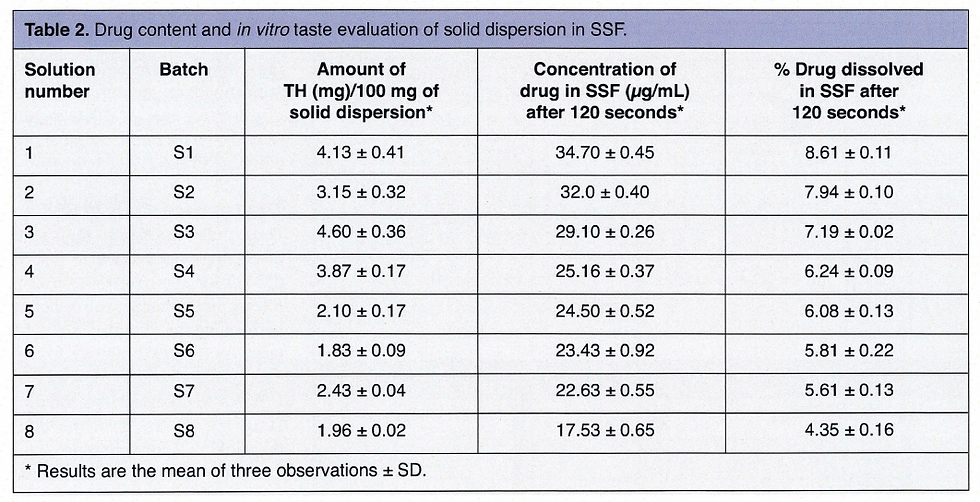
Solid dispersion (100 mg) was dissolved in 100 mL of acid buffer pH 1.2. After suitable dilution , drug content was estimated UV spectrophotometrically at 320 nm using acid buffer at pH 1 .2 as a
blank (Table 2).
Fourier transform infrared (FTIR) spectroscopy
FrIR spectra of TH, MC, the physical mixture of TH and MC, and the solid dispersion were obtained by KBr disc method (8400 S, Shimadzu Asia Pacific Pvt. Ltd, Singapore) in the range of 4000 to 500
cm·1 (Figure 1).

Differential scanning calorimetry (DSC)
DSC analysis of TH, MC, d-sorbitol , the physical mixture of TH, MC and d-sorbitol, and the solid dispersion was performed using a DSC equipped with computer analyser (DSC Metlar Toledo
DSC 821, Japan). Samples (4- 6 mg) were heated under nitrogen atmosphere on an aluminium pan
at a heating rate of l0°C/minute over the temperature range of 50- 350°c (Figure 2) .

Drug release study in SSF
Drug release from the solid dispersion was studied in SSF at pH 6.2 for approximation of drug
release in the human saliva before performing the volunteer study for taste. As it takes 2 minutes to pass over the epiglottis11 •12 , drug release in SSF was observed for 2 minutes.
Drug release less than the bitter threshold concentration in 2 minutes was considered the lag
time. A solid dispersion equivalent to 4 mg of TH was taken in a 25 mL volumetric flask . To this,
10 mL of SSF was added and shaken for 120 seconds 17 . AO .5 mL aliquot of the sample was
withdrawn and diluted suitably with SSF. The amount of drug released was analysed
spectrophotometrically at 320 nm (Table2) .
Formulation of RDTs
All the ingredients were weighed, mixed and compressed into tablet form using an 8 mm flat-faced
punch on a single tablet punching machine under the compressional force of 8 KN. Composition of the
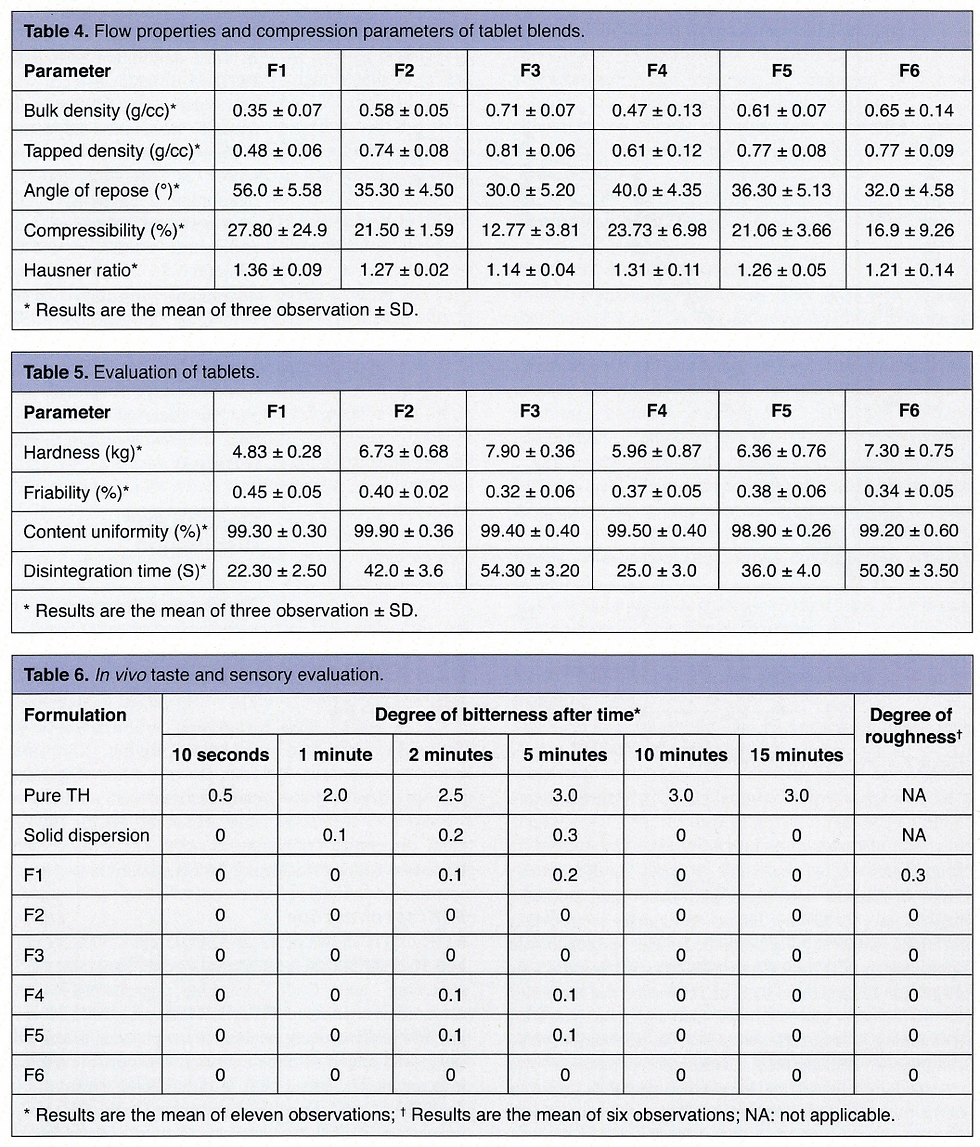
TH RDT by the direct compression method is shown in Table 3. Flow properties and compression parameters of the tablet blend (Table 4) and the physical properties of the tablets were determined (Table 5).

Evaluation of RDTs
Drug content
Ten tablets were taken and triturated in a glass mortar. The powdered tablet equivalent to 4 mg of solid dispersion of drug was dissolved in a 100 rnL acid buffer at pH 1.2 and the drug content was determined spectrophotometrically at 320 nm (Table 5).
In vitro disintegration
In vitro disintegration time of the RDTs was determined using a modified disintegration apparatus designed by Khan et a/17 . Briefly, the apparatus consisted of a glass beaker (1000 rnL) with the wire basket positioned in the beaker with the aid of a support in a way that when the beaker contained 900 rnL of disintegrating medium (SSF pH 6.2) , the basket had only 6 rnL of it. A magnetic bead was placed at the bottom of the beaker maintained at 37 ± 2°C and a tablet was placed in the basket. Disintegration time was determined at 25 rpm (Table 5) .
In vivo taste evaluation and sensory evaluation of roughness
Taste evaluation was performed using time intensity method on 11 healthy human volunteers from hom
informed consent was obtained. The protocol was approved by the Investigational Review Board. Solid
dispersion equivalent to 4 mg of TH was held in the mouth for 10 seconds and then spat out and then one RDT ( containing 4 mg TH) was held in the mouth until completely disintegrated. Bitterness perception was recorded immediately and at several time points for a total of 15 minutes according to the bitterness intensity scale from Oto 3, where 0, 0.5, 1, 2, and 3 indicate no, threshold, slight, moderate, and strong bitterness, respectively. After the study, the mouth was rinsed with water18 . The results
are shown in Table 6.
Sensory evaluation was completed on six volunteers from whom informed consent was obtained. One tablet was held in the mouth and allowed to disintegrate. The disintegrated material was retained for 60 seconds and then spat out. The mouth was rinsed with water without swallowing the disintegrated material and finally the roughness levels were scored as 0, 1 and 2 indicating not rough, slightly rough and markedly rough, respectively19 (Table 6).
In vitro dissolution study inacid buffer pH 1.2
In vitro dissolution testing of RDTs of different batches was performed using USP type II (paddle) dissolution apparatus at 50 rpm and 500 mL acid buffer at pH 1.2 as the dissolution medium. The temperature of the medium was maintained at 37 ± 0.5°C. Aliquots (5 mL) of the dissolution medium were withdrawn at specific time intervals, diluted suitably and analysed by a UV-visible spectrophotometer at 320 nm, and the cumulative percentage drug release was determined (Figure 3).

Results and discussion
Threshold bitterness concentration of TH and drug content in solid dispersion
The threshold bitterness concentration of TH was found to be 20 μglmL. The drug content of solid dispersion ranged from 1.83 ± 0.88 to 4.71 ± 0.34 mg TH per 100 mg solid dispersion for batches Sl-S8. The drug content decreased with increasing polymer concentration.
FTIR spectroscopy
FfIR of TH shows peaks at 3244.05 cm- 1, 3072.39 cm·' and 1643.24 cm·1 due to secondary NH stretching, C-H stretching and C=N stretching, respectively. The characteristic peaks of TH at 3244.05 cm·', 3072.39 cm·' and 1643.24 cm·' were retained in the physical mixture of drug, MC and d-sorbitol confirming no drug-excipient interaction. The broad peak between 3600-3100 cm·' in the FfIR of solid dispersion is attributed to the OH group, which may be due to the formation of an intermolecular
H-bond between the NH group of TH and the OH group of d-sorbitol.
DSC
DSC of TH showed a sharp endothermic peak at 290°C while d-sorbitol and MC showed melting endothermic peaks at 90°C and 130°C, respectively. DSC of the physical mixture of MC, d-sorbitol and TH showed retention of the melting peak at 290°C of TH. The sharp endothermic peak at 290°C in the DSC of TH is attributed to the melting of the drug whilst the appearance of an additional endothermic peak in the DSC of the physical mixture of MC and TH near 120°C is due to dehydration of MC. In the solid dispersion, the melting peak of MC had shifted to 148°C. Shifting of the melting peak of MC
to 148°C in the solid dispersion might be due to greater intermolecular interaction between MC molecules as a consequence of the salting-out effect of d-sorbitol followed by precipitation of MC during formation of the solid dispersion. Thus, more energy was required to break them apart.
The melting endotherm of TH had shifted to 283°C (Figure 2) and was also found broadened in the solid
dispersion. The decrease in melting temperature and broadening of the peak of TH in the DSC of the solid dispersion might be due to the decrease in crystallinity of the drug after dispersion.
In vitro taste evaluation
Percentage drug release from solid dispersions S 1-S8 in pH 6.2 SSF after 120 seconds was found between 8.61 ± 0.11% to 4.35 ± 0.16%. Solid dispersions S4 and S8 containing 30% w/v d-sorbitol gave 6.24 ± 0.09% and 4.35 ± 0.16% drug release , respectively, in simulated SSF at pH 6.2 in 120 seconds. The percentage drug release from S8 corresponds to the mean concentration 17.53 ± 0.65 μg/mL which is less than the threshold bitterness concentration (20 μg/mL). Sorbitol, which is responsible for salting-out and precipitation of MC during the formation of the solid dispersion of TH prevented MC from dissolving in SSF, which is a fairly water-soluble polymer. The slow dissolution of MC suppressed drug release in SSF13 . Sorbitol (a polyol), owing to its high water solubility20 , competes for water and dissolves first, causing slower dissolution of MC, which consequently retarded the drug release in SSF. With the rise in percentage of sorbitol in the dispersion , drug release was decreased. Solid dispersions S4 and S8 had the same level of sorbitol, but drug release from S8 was less as it had a lower percentage
of drug.
Flow properties and compression behaviour of tablet blend
Tablet blend Fl (with Avicel PH 105 as the filler) had the lowest bulk density and very poor flow property
(angle of repose 56 ± 5.58°). High percentage compressibility (27 .82 ± 4.9%) and Hausner ratio (1.36 ± 0.09) also demonstrated poor flow character of blend Fl . Fl showed very poor flow behaviour because it consisted of only Avicel PH 105 as the filler. Avicel PH 105 possesses low bulk density and very small particle size (20 μm) and therefore its flow property is poor. When Avicel PH 105 was replaced with spraydried mannitol in blend F2, flow property improved. The angle of repose of blend F2 was 35.3 ± 4.5° while compressibility index and Hausner ratio were 21.5 ± 1.59% and 1.27 ± 0.02, respectively.
Tablets with blend F3 which had dextrate as the filler had the highest bulk density (0.71 ± 0.07 glee) and showed excellent flow behaviour (angle of repose 30 ± 5.2°, compressibility index 12.77 ± 3.81 % and Hausner ratio 1.14 ± 0.04). The addition of spray-dried mannitol or dextrate to Avicel PH 105 in a 1: 1 ratio as the filler improved flow behaviour of the tablet blends, because spray-dried mannitol has a free-flowing granular characteristic21, and dextrate is composed of porous spheres that have excellent flow properties22 . Flow behaviour of blend F4 was fair (angle of repose 40 ± 4.35°) while it was good in blend F5 (angle of repose 36.3 ± 5.13°).
Evaluation of RDTs
Hardness and disintegration time Tablets containing dextrate as filler (F3) were hardest (hardness 7.9 ± 0.36 kg) followed by those containing spray-dried mannitol (F2, hardness 6.73 ± 0.68 kg) and Avicel PH 105 (Fl, hardness 4.83 ± 0.28 kg) as filler. Fl , despite having Avicel alone as the filler, had good hardness because Avicel PH 105 has greatest compactibility amongst all grades of microcrystalline celluloses due to its smaller size, which increases bonding surface area. The compaction behaviour of powders
depends on the deformation behaviour and their intrinsic bonding properties. Primary particles of mannitol exhibit plastic deformation and form a large surface area for bonding21 .
Consolidation of dextrate is reported to arise by plastic deformation of the porous particles that occurs along many planes giving a large surface area for bonding22 . Hence, formulations F2 and F3 containing spray-dried mannitol and dextrate produced harder tablets. Disintegration of tablet blend Fl (which contained only Avicel PH 105) was fastest (22.3 ± 2.5 seconds) . Tablets with mannitol (F2) or dextrate (F3) disintegrated relatively slowly. Combination of Avicel witharnannitol in the ratio 1: 1 (F4) resulted in a rise in the tablet strength (hardness 5.96 ± 0.87 kg) , but maintained the rapid disintegrating property imparted by Avicel PH 105 disintegration time 25 ± 3 seconds). Fl fragmented most rapidly because Avicel has the ability to promote disintegration quickly. Although the hardness of tablets increased when mannitol was added to formulations containing Avicel (F4), the rapid disintegrating property of the tablets was maintained because mannitol is less soluble when compared to other polyols and allows water penetration into the tablet21 . Formulation F3 containing dextrate showed longer disintegration time because dextrate is highly water soluble and starts dissolving from
the surface with poor penetration of water into the tablet22 .
In vivo taste and sensory evaluation TH was perceived as an intensely bitter material while the solid dispersion and RDTs were scored as non-bitter by the volunteers. The taste masking was significant with
p<0.01 (ANOVA followed by Dunnett test). RDTs did not give a feeling of roughness after disintegration in the mouth. Two out of six volunteers felt slight roughness with formulation Fl but others felt it smooth, therefore the average score was 0.3. The bitter taste of TH was masked in the solid dispersion because the salting-out agent, dsorbitol, present in the solid dispersion retarded dissolution of MC which consequently prevented drug release in the mouth. Sorbitol, being highly water soluble dissolves first preventing MC from dissolving, which consequently retarded drug release. In addition, the dissolution of sorbitol imparts sweetness and a pleasant mouth feel.
In vitro dissolution studies in acid buffer pH 1.2 All formulations showed initial slow drug release
followed by rapid release in acid buffer pH 1.2. Drug release was fastest from Fl (98 ± 0.9 % in 15 minutes) which had Avicel PH 105 as the filler. Formulations which had spray-dried mannitol (F2) and dextrate (F3) as the filler showed slower drug release than Fl. Formulation with dextrate (F3) gave the slowest drug release (87 .83 ± 1.75 % in 20 minutes). Formulation F4 containing a combination of Avicel and spray-dried mannitol in a I: I ratio maintained rapid drug release (95.26 ± 0.64 % in 15 minutes). The initial slow release was due to the presence of sorbitol in the solid dispersion. As described previously, sorbitol having high affinity for water20 dissolves first , retarding the dissolution of MC. Also the salting-out of MC by sorbitol during formation of the solid dispersion resulted in increased hydrophobic interaction among MC molecules, which caused poor dissolution of MC. After the sorbitol was completely dissolved, the tablet mass became porous with greater penetration of water and
subsequent rapid drug release. Formulation F2 gave slower drug release than Fl because the diluent spraydried mannitol in F2 primarily dissolves owing to its good water solubility, and reduces water penetration into the tablet, consequently leading to poor swelling of crosspovidone with subsequent delay in disintegration time. Formulation F3 gave the slowest drug release because dextrate was the diluent. Dextrate owing to its very high water solubility caused the tablet to dissolve poorly due to the very poor penetration of water, leading to the longest disintegration time22 . Formulation F4, despite containing spray-dried mannitol, maintained rapid drug release because mannitol is less soluble in
water compared to other polyols thus allowing water penetration into the tablet21 . Additionally, it could be theorised that the Avicel present in the formulation promotes water penetration .
Conclusion
A taste-masked solid dispersion of TH was successfully prepared by a cost-effective, simple and scalable technique using MC and d-sorbitol. Solid dispersion formulation S8 containing MC:d-sorbitol in the ratio 2:3 with TH 5% w/w of MC released detectable TH less than the threshold bitterness concentrations in SSF. RDTs of the solid dispersion containing a combination of Avicel PH 105 and spray-dried mannitol as diluents (F4) showed good hardness, rapid disintegration, a pleasant taste, a
smooth feeling and rapid drug release in acid buffer.
References
1. Matsui D. Current issues in pediatric medication adherence. Paediatric Drugs 2007;9:283-288 .
2. Lindemann B. Receptors and transduction in taste. Nature 2001 ;413:219-225.
3. Roche EJ, Papile SM and Freeman EM. Rotogranulations and taste masking coatings for preparation of chewable pharmaceutical tablets. US Patent US5260072; 9 November 1993.
4. Hamashita T, Matsuzaki M, Ono T, Ono M, Tsunenari Y, Aketo T and Watano S. Granulation of core particles suitable for film coating by agitation fluidized bed II. A proposal of a rapid dissolution test
for evaluation of bitter taste of ibuprofen . Chemical and Pharmaceutical Bulletin (Tokyo) 2008;56:883-887.
5. Douroumis DD, Gryczke A and Schminke S. Development and evaluation of cetirizine HCI taste-masked oral disintegrating tablets.AAPS PharmSciTech 2011. doi: 10.1208/sl2249-010-9569-7.
6. Borodkin N and Sundberg DP. Polycarboxylic acid ion exchange resin adsorbates for taste coverage in chewable tablets. Journal of Pharmaceutical Sciences 1971 ;60: I 523-1527.
7. Suthar AM and Patel MM. formulation and evaluation of taste masked suspension of metronidazole. International Journal of Applied Pharmaceutics 2011 ;3:16-19.
8. Patel AR and Va via PR. Preparation and evaluation of taste masked famotidine formulation using drug/B-cyclodextrin/polymer ternary complexation approach. AAPS PharmSciTech 2008. doi:
J0.1208/s12249-008-9078-0
9. Shah PP and Mashru RC. Development and evaluation of artemether taste masked rapid disintegrating tablets with improved dissolution using solid dispersion technique. AAPS PharmSciTech 2008. doi: IO .1208/s 12249-008-9066-4.
10. Morita T. Development of deglutition aid jelly for oral administration. Yakugaku Z,asshi 2003;123:665-671 .
11. Helm JF, Dodds WJ, Riedel DR, Teeter BC, Hogan WJ and Arndorfer RC. Determinants of esophageal acid clearance in normal subjects. Gastroenterology l 983;85:607-612.
12. Oguchi K, Saitoh E, Mizuno M, Baba M, Okui M and Suzuki M. The repetitive saliva swallowing test (RSST) as a screening test of functional dysphagia (I) normal values of RSST. Japanese Journal
of Rehabilitation Medicine 2000;37:375-382.
13. Yoshida T, Tasaki H, Maeda A, Katsuma M, Sako K and Uchida T. Salting-out taste-masking system generates lag time with subsequent immediate release. International Journal of Pharmaceutics 2009;365:81-88.
14. Itoh K, Hatakeyama T, Kimura T, Shimoyama T, Miyazaki S, D'emanuele A and Attwood D. Effect of D-sorbitol on the thermal gelation of MC formulations for drug delivery. Chemical and Pharmaceutical Bulletin 2010;58:247- 249.
15. Galichet LY. Clarke's Analysis of Drugs and Poisons in Pharmaceuticals, Body Fluids and Post Mortem Material, 3rd edition. London , UK: Royal Pharmaceutical Society of Great Britain
Pharmaceutical Press; 2004, pp. 1641.
16. Yan YD, Woo JS , Jang JH and Yong CS. Preparation and evaluation of taste masked donepezil hydrochloride orally disintegrating tablet.Biological and Pharmaceutical Bulletin 2010;33:1364-1370.
17. Khan S, Kataria P, Nakhat P and Yeole P. Taste masking of condensetron HCI by polymer carrier system and formulation of rapid disintegrating tablet. AAPS Pharm Sci Tech 2007;8(2):El- E7.
18. Nakamura T, Tanigake A, Miyanaga Y, Ogawa T, Akiyoshi T, Matsuyama K and Uchida T. The effect of various substances on the suppression of the bitterness of quinine- human gustatory sensation,
binding, and taste sensor studies. Chemical and Pharmaceutical
Bulletin (Tokyo) 2002;50:1589-1593.
19. Ishikawa T, Mukai B, Shiraishi S, Utoguchi N, Fujii M, Matsumoto M and Watanabe Y. Preparation of rapidly disintegrating tablet using new types of microcrystalline cellulose (PH-M series) and low
substituted-hydroxypropylcellulose or spherical sugar granules by direct compression method. Chemical and Pharmaceutical Bulletin 2001 ;49: 134-139.
20. O'Neil MJ. The Merck Index - An Encyclopedia of Chemicals, Drugs, and Biologicals. Kenilworth, NJ, USA: Merck and Co.; 2006,pp 1498.
21. Bolhuis GK, Rexwinkel EG and Zuurman K. Polyols as fillerbinders for disintegrating tablets prepared by direct compaction.Drug Development and Industrial Pharmacy 2009;35:671-677.
22. Bolhuis GK and Holzer AW. Compaction properties of directly compressible materials. In: Pharmaceutical Powder CompactionTechnology . Metin C, Ed. London, UK: Informa Healthcare UK;
2011,pp.143-204.



Comments