
Peer Review Article | Open Access | Published 2 July 2026
Characterization And In-Vitro Optimization Of Caffeine-Incorporated Mucoadhesive Microsphere
Ankan Pradhan¹, Krishnendu Ghosh¹*, Koushik Sen Gupta², Swagatika Das³, Nabanita Banik⁴ | EJPPS | DOI https://doi.org/10.37521/ejpps31202
Abstract
The present study focuses on the formulation and evaluation of mucoadhesive microspheres for controlled drug delivery using sodium alginate, HPMC, and Carbopol 934P as polymeric carriers. Microspheres were prepared by the ionotropic gelation technique employing calcium chloride as a crosslinking agent. The prepared formulations were assessed for percentage yield, particle size, swelling index, drug entrapment efficiency, and flow properties. FTIR analysis confirmed the absence of drug–excipient interactions, indicating compatibility of the selected materials. The microspheres exhibited sustained drug release, and in vitro dissolution studies using the USP Type II apparatus revealed that the release followed predominantly Higuchi and Korsmeyer–Peppas kinetics, suggesting a diffusion-controlled mechanism. Among all formulations, F₃ demonstrated optimal physicochemical characteristics with enhanced mucoadhesion and sustained release behaviour. The findings highlight the potential of polymer-based mucoadhesive microspheres as an effective approach for improving drug bioavailability and achieving site-specific controlled delivery.
Keywords: Drug delivery system (DDS), Controlled release, Sustained release, Mucoadhesive microspheres, Microsphere-based drug delivery, Ionic gelation method, Caffeine, Caffeine microspheres
Introduction
Drug delivery systems are important in modern therapeutics since they not only impact the efficacy of a drug but also influence patient compliance and treatment results. This makes them an essential component of modern therapeutics. Ensuring that a sufficient amount of the active pharmaceutical ingredient reaches the site of action at the appropriate time and for a sufficient duration to generate the desired therapeutic effect is the fundamental goal of any drug delivery system. Conventional dosage forms, particularly oral formulations, remain the most common route of administration owing to their ease of use and patient acceptance. However, such systems are often associated with inherent limitations, including poor control over drug release, unpredictable absorption, and wide fluctuations in plasma drug concentration. These shortcomings frequently lead to inadequate therapeutic responses, increased risk of toxicity, and the need for frequent dosing.¹
Significant research has been focused on creating novel drug delivery devices that can achieve controlled and sustained drug release in response to these difficulties. Controlled-release formulations are specifically designed to deliver the drug at a predetermined rate, thereby maintaining steady-state concentrations for prolonged periods. This not only reduces dosing frequency but also minimizes systemic side effects and improves patient adherence. Several strategies have been explored in this regard, including polymeric matrices, rate-controlling membranes, biodegradable carriers, liposomes, nanoparticles, and microspheres. Among these, microsphere-based drug delivery systems have shown enormous potential, as they offer uniform drug encapsulation, protection of labile molecules, and the ability to modulate release kinetics.²
A particularly promising advancement in this field is the development of mucoadhesive microspheres. These systems combine the advantages of microspheres with the unique property of bioadhesion, allowing them to adhere to mucosal surfaces such as the oral, nasal, ocular, vaginal, and rectal mucosa. The intimate contact with the mucosal layer not only prolongs the residence time of the formulation but also enhances drug absorption and bioavailability, especially for molecules that undergo extensive first-pass metabolism or have poor solubility. Furthermore, mucoadhesive microspheres facilitate site-specific delivery, reduce drug loss during transit, and extend the duration of therapeutic action.³,⁴
The effectiveness of these systems largely depends on the choice of bioadhesive polymers, which interact with mucin through hydrogen bonding, electrostatic interactions, or chain entanglement. Polymers such as chitosan, carbopol, and hydroxypropyl methylcellulose are widely investigated for their excellent mucoadhesive properties and biocompatibility. By tailoring the polymer composition and microsphere formulation, it is possible to achieve optimal drug loading, release profiles, and adhesion characteristics.⁵,⁶
Given their multifaceted advantages, mucoadhesive microspheres represent a versatile platform for controlled and targeted drug delivery. They not only address the limitations of conventional dosage forms but also open new opportunities for improving therapeutic efficacy, reducing adverse effects, and enhancing patient convenience. Therefore, as a unique approach to enhance drug delivery performance and get around the problems with conventional drug administration methods, the current study focuses on the design, formulation, and assessment of mucoadhesive microspheres.⁷
MATERIALS AND METHODS

Ionic Gelation Technique
The ionic gelation method, introduced by Lim and Moss, involves dissolving sodium alginate in aqueous solution, incorporating the drug, and dropping the dispersion into a calcium chloride solution under stirring. Calcium ions crosslink the alginate to form calcium alginate microspheres through ionotropic gelation. Since alginate alone shows rapid swelling and erosion in alkaline media, polymers such as HPMC or Carbopol are often added to improve sustained release properties. The formed microspheres are collected, washed, and dried to obtain stable spherical particles.
Microsphere preparation (Ionic Gelation Method):
Sodium alginate and mucoadhesive polymers (HPMC and Carbopol 934, 1:1) were distributed in purified water to obtain a uniform mixture. The drug was incorporated into the viscous dispersion, which was then added dropwise into calcium chloride solution (5–15% w/v) under continuous stirring. The droplets were cured for 15 minutes to form rigid microspheres, collected by decantation, washed with purified water to remove extra calcium, and dried at 45°C for 24 hrs.⁵,⁸

CHARACTERIZATION OF FORMULATION
Compatibility Study
Drug-excipient compatibility studies are essential in formulation development to ensure stability and efficacy. Excipients, though pharmacologically inactive, may interact chemically or physically with the active drug, potentially leading to instability or formation of new entities with altered properties. These studies help in selecting suitable excipients, optimizing dosage forms, and preventing formulation-related issues, thereby ensuring consistent drug performance and physicochemical stability.⁹,¹⁰
Flow Properties
The flow characteristics of the prepared mucoadhesive microspheres were evaluated by measuring bulk and tapped densities in a 10 ml graduated cylinder. After tapping 100 times, Carr’s compressibility index and Hausner’s ratio were calculated to assess flowability.¹¹
Percentage Yield
The microspheres were collected and weighed after being processed. The % yield was computed as follows:
Percentage yield = (Definite weight of microspheres/Overall weight of materials used) × 100
Drug Entrapment Efficiency
After suspending two grams of microspheres in one hundred millilitres of water, the mixture was agitated and sonicated for twenty-four hours. After filtering the suspension to get rid of shell pieces, the drug content was measured using spectrophotometry at 273 nm.¹²
Swelling Index
For two hours, 100 mg microspheres were suspended in 5 ml of pH 1.2 simulated stomach juice and then transferred to pH 6.5 buffer for 6 hrs. The weight increase was measured hourly using a digital balance to calculate the swelling index over 8 hrs.
Determination of Particle Size
Particle size, which influences drug release characteristics, was measured using an optical microscope. A small quantity of dried microspheres was suspended in glycerine, and by using a compound microscope fitted with a calibrated ocular and stage micrometre, the diameters of 100 microspheres per batch were measured. Microspheres in the study ranged from 1 to 1000 µm, and the average particle size was calculated for each batch.¹³,¹⁴
In vitro Dissolution Analysis
In vitro release of drug was performed with a six-basket USP Type II (paddle) device. Caffeine microspheres (200 mg) were placed in dialysis membranes and suspended in the dissolution medium using a paddle. The buffer change method simulated gastrointestinal conditions, with acidic pH 1.2 for the first 2 hrs. and alkaline pH 6.8 for the remaining period of time. The medium was retained at 37 ± 0.5 °C with a revolution speed of 100 rpm. At each interval of 30 min, 5 ml samples were withdrawn up to 8 hrs, filtered (5 μm), diluted with fresh medium, and examined at 273 nm by a UV spectrophotometer. Withdrawn volumes were replaced with fresh medium, and cumulative drug release was calculated from a standard calibration curve.¹⁵,¹⁶
Examination of the release pattern and kinetics
Drug release from caffeine microspheres was analysed using zero-order, first-order, Higuchi, Hixson-Crowell, Korsmeyer-Peppas, and Baker-Lonsdale models to evaluate release kinetics and mechanisms. The best-fit model was determined by comparing R² values. Calculations were performed using Microsoft Excel.¹⁷
RESULT AND DISCUSSION:
Compatibility Study


Sample | Characteristic Peaks (cm⁻¹) | Functional Group Assignment | Observation in Combination | Interpretation |
Pure Drug (Caffeine) | 2954, 1699, 1658, 1548, 1430 | C–H (CH₃), C=O, C=N, C=C, aromatic C–H | All peaks retained in the combination spectrum | Drug structure intact |
Sodium Alginate | Broad 3400–3200, 1600–1400, 1020 | O–H stretch, COO– stretch, C–O–C | Peaks present without shift | No drug–polymer interaction |
HPMC | 3400 (O–H), 2920 (C–H), 1060 (C–O–C) | Hydroxyl and ether groups | No changes observed | Compatible with drugs |
Carbopol 934 | 3000–2500 (O–H broad), 1700 (C=O), 1240 (C–O) | Carboxylic acid and polymer backbone | No significant peak shift | Compatible |
Drug–Excipient Combination | Retains major drug peaks at ~2950, ~1700, 1650, and 1540; polymer peaks are also present. | Shows presence of drug and polymers | No new peaks; no disappearance | Indicates compatibility; no chemical interaction |
Table 3. Comparative FTIR Analysis of Caffeine and Excipients
FTIR analysis of individual components
The FTIR spectrum of pure caffeine exhibited a prominent C–H stretching band at 2954 cm⁻¹, a strong carbonyl (C=O) stretching peak at 1699 cm⁻¹, and a combined C=O/C=N/C=C vibration at 1658 cm⁻¹. Aromatic C–H bending modes were observed between 1548–1430 cm⁻¹, consistent with previously reported spectral features of caffeine.
Sodium alginate displayed a characteristic broad O–H stretching band in the range of 3400–3200 cm⁻¹, along with asymmetric and symmetric COO⁻ stretching vibrations appearing between 1600–1400 cm⁻¹. A typical C–O–C stretching band around 1020 cm⁻¹ confirmed the presence of glycosidic linkages in the polymer.
HPMC revealed its distinct polymeric vibrational pattern, including strong C–O–C stretching vibrations at around 1060 cm⁻¹, a wide O–H stretching band at about 3400 cm⁻¹, and C–H stretching at about 2920 cm⁻¹. Carbopol 934 exhibited characteristic peaks within 3000–2950 cm⁻¹ due to O–H stretching, a carbonyl stretching band at ~1717 cm⁻¹, C–O–C stretching at 1160–1115 cm⁻¹, and acrylic functional group vibrations between 1250–1200 cm⁻¹. A peak at ~800 cm⁻¹ was associated with out-of-plane C=CH bending.
FTIR analysis of drug–excipient combination
The FTIR spectrum of the caffeine–polymer physical mixture retained all the principal peaks of caffeine, with no significant shift in the C–H stretching (≈2950 cm⁻¹), carbonyl stretching (~1700 cm⁻¹), or aromatic vibration regions (1650–1540 cm⁻¹). Similarly, the characteristic spectral bands of sodium alginate, HPMC, and Carbopol 934 appeared at their respective positions in the combination spectrum. No new absorption bands, disappearance of major peaks, or marked peak broadening were observed, suggesting the absence of chemical interaction.
Compatibility assessment
The preservation of the major functional group vibrations of caffeine in the presence of the selected polymers indicates that the drug maintains its molecular structure in the blend. The absence of additional peaks or significant spectral shifts in the combination spectrum confirms that no chemical reaction, complex formation, or degradation occurred between caffeine and the excipients. Any minor intensity variations are attributable to physical mixing and overlapping of polymeric O–H and C–O–C bands.
Therefore, FTIR analysis indicates satisfactory drug–excipient compatibility, supporting the suitability of sodium alginate, HPMC, and Carbopol 934 for formulation development.

Flow Properties
Flow properties of the prepared microspheres were assessed using Hausner's ratio and Carr's compressibility index, which are computed using bulk and tapped densities. The compressibility index ranged from 5.00 to 15.21%, and Hausner’s ratio ranged from 1.05 to 1.17, indicating excellent flowability for all formulations. Among them, F₈ exhibited the best flow characteristics with the lowest compressibility index and Hausner’s ratio.
Percentage Yield
The percentage yield of microspheres varied between 73.53–91.04%. Formulations containing Carbopol 934 exhibited comparatively higher yields than those with HPMC. Improved yields were achieved with 10–15% CaCl₂, attributed to better crosslinking, while the 5% solution produced insufficient hardening, leading to lower yield. Excessive viscosity at higher concentrations also caused syringe blockage and drug-polymer loss.
Drug Entrapment Efficiency
Entrapment efficiency ranged from 78.11–95.15%. Efficiency improved with increasing polymer concentration due to higher viscosity and greater availability of calcium-binding sites, resulting in larger droplets capable of entrapping more drug. Formulations with copolymers (HPMC, Carbopol 934) showed higher entrapment than sodium alginate alone. Among all, F₆ (94.06%), F₈ (94.79%), and F₁₀ (95.15%) exhibited the highest efficiencies, while F₁ showed the lowest (78.11%).
Swelling Index
The swelling index of microspheres ranged from 12.66% to 18.46% at pH 1.2 and 59.59% to 73.56% at pH 6.8. Swelling was lower in acidic medium but increased significantly in basic medium due to greater penetration and ionization of functional groups. The swelling behaviour was influenced by polymer concentration, copolymer type, and viscosity. Formulations containing both HPMC and Carbopol 934 showed superior swelling compared to single-polymer systems. Among all, F₁₀ (HPMC: Carbopol 934, 1:1) exhibited the highest swelling index (73.56%) at pH 6.8. The gradual hydration and gel barrier formation sustained the integrity of microspheres, supporting controlled release.
Particle Size
The average particle size of microspheres is from 815.64 to 879.21 μm. Particle size increased with polymer viscosity and higher CaCl² concentration, indicating their direct influence on microsphere enlargement during formulation.
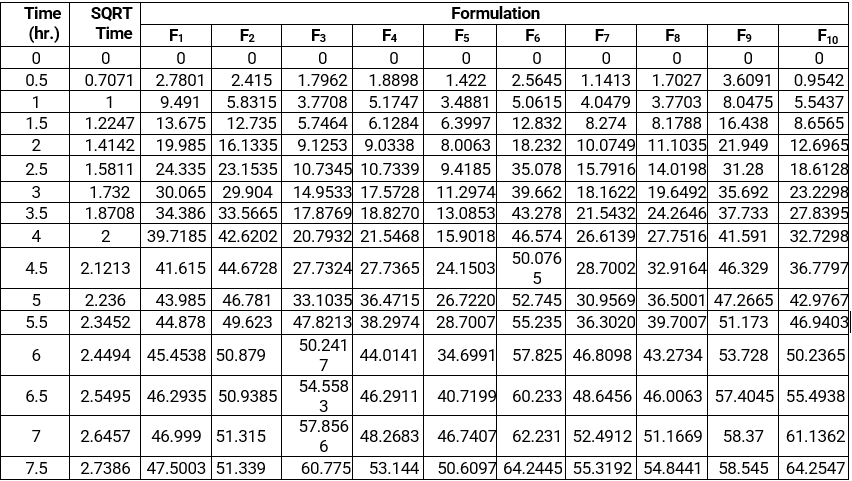
Table 6. In vitro dissolution study of caffeine microspheres
The release of caffeine from microspheres was influenced by copolymer type, polymer concentration, and CaCl² level. Drug release in acidic medium (pH 1.2) during the first 2 hrs. was low (<18%), indicating minimal release in gastric conditions due to reduced swelling. Upon transfer to basic medium (pH 6.8), microspheres exhibited sustained release, governed primarily by diffusion through swollen polymer matrices and subsequent polymer disintegration.
An increase in CaCl₂ concentration generally enhanced drug release, except for F₂ and F₃, where stronger drug–polymer binding slowed release. At 8 hrs., cumulative release ranged from 47.77% (F₁) to 68.07% (F₆). Among all, F₆ (68.07%) showed the most desirable controlled release profile, sustaining drug delivery for up to 8 h, suggesting improved absorption and bioavailability.

Table 7. Values of Log % of the amount remaining of drug of each formulation for hours

Table 8. Log Cumulative % Drug Release Data of Each Formulation for 8 Hours

Table 9. Difference between cube root data of initial weight and weight at time t


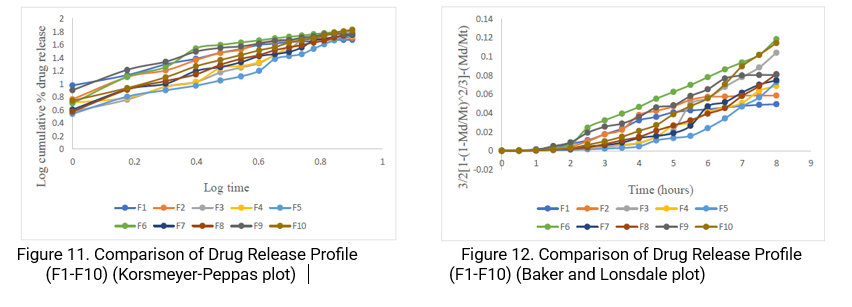
Analysis of release kinetics and mechanism:

(where R² = correlation coefficient; K₀ = Constant (zero-order); K₁= Constant (first-order); KH = Higuchi constant; KHC= Hixson-Crowell constant; n = Korsmeyer-Peppas constant/release exponent; KB= Baker & Lonsdale constant)
The prepared formulations released the drug for up to 8 hrs. Formulations F₃, F₄, F₅, F₇, F₈, and F₁₀ followed the zero-order model, while F₁, F₂, F₆, and F9 followed the Baker–Lonsdale model, based on their higher correlation coefficient (R²) values.
The release exponent (n) values from the Korsmeyer–Peppas plot extended from 0.786 to 1.465, indicating both anomalous (0.45 < n < 0.89) and super case II (n > 1.0) transport mechanisms.
Formulations F₁ and F₂ demonstrated anomalous (non-Fickian) diffusion, in which polymer swelling and diffusion led to drug release. Other formulations exhibited super case II transport, governed mainly by polymer chain relaxation and erosion.
Conclusion
In this investigation, caffeine-loaded mucoadhesive microspheres were effectively made using the ionotropic gelation method with HPMC and Carbopol 934P as copolymers and sodium alginate as the primary polymer. All polymers exhibited outstanding mucoadhesive properties and contributed to sustained drug release.
The pre-formulation studies confirmed the identity, purity, and compatibility of caffeine with the selected excipients based on FTIR analysis. The microspheres showed excellent flow properties, a satisfactory percentage yield (73.53–91.04%), and high drug entrapment efficiency (78.11–95.15%). The particle size ranged between 815.64–879.21 μm, and the swelling index increased with pH, indicating pH-dependent swelling behaviour.
In vitro drug release studies demonstrated sustained release of caffeine for up to 8 hours. Formulations F₃, F₄, F₅, F₇, F₈, and F₁₀ followed zero-order kinetics, while F₁, F₂, F₆, and F₉ followed the Baker–Lonsdale model. The Korsmeyer–Peppas analysis revealed both anomalous and super case II transport mechanisms, indicating that drug release was governed by a combination of diffusion and polymer relaxation.
Among all formulations, F₆ and F₁₀ were identified as optimized based on drug entrapment efficiency (94.06% and 95.15%) and drug release (68.08% and 67.17%, respectively). F₆ followed the Baker–Lonsdale model, while F₁₀ followed the zero-order model.
Overall, the study confirmed that mucoadhesive microspheres offer a promising approach for sustained and site-specific delivery of caffeine for headache treatment, improving bioavailability and patient compliance. Formulations F₆ and F₁₀ can be considered for further in vivo and stability studies to develop an effective oral mucoadhesive dosage form.
LIST OF ABBREVIATIONS
Abbreviation | Full Form |
FTIR | Fourier Transform Infrared Spectroscopy |
UV | Ultraviolet |
USP | United States Pharmacopeia |
RPM | Revolutions Per Minute |
HPMC | Hydroxypropyl Methylcellulose |
CaCl2 | Calcium Chloride |
KCl | Potassium Chloride |
HCl | Hydrochloric Acid |
Na2HPO4 | Disodium Hydrogen Phosphate |
KH2PO4 | Potassium Dihydrogen Phosphate |
CaCl2 2H2O | Calcium chloride dihydrate |
% (w/v) | Percentage weight/volume |
µm | Micrometre |
ml | Millilitre |
min | Minute |
mg | Milligram |
℃ | Degree Centigrade |
Hrs. | Hours |
pH | Potential of Hydrogen |
R² | Coefficient of Determination |
F1, F2…F10 | Formulation 1, Formulation 2 … Formulation 10 |
CONFLICT OF INTEREST
The authors have no conflicts of interest regarding this investigation.
ACKNOWLEDGMENTS
The authors would like to thank Himalayan pharmacy institute and University of North Bengal for their kind support during our research work.
References
1. Phanindra B, Moorthy BK, Muthukumaran M. Recent advances in mucoadhesive/bioadhesive drug delivery system: A review. Int J Pharma Med Biol Sci. 2013 Jan;2(1):68-84.
2. Singla AK, Chawla M, Singh A. Potential applications of carbomer in oral mucoadhesive controlled drug delivery system: a review. Drug development and industrial pharmacy. 2000 Jan 1;26(9):913-24. https://doi.org/10.1081/DDC-100101318
3. Patil H, Tiwari RV, Repka MA. Recent advancements in mucoadhesive floating drug delivery systems: A mini-review. Journal of Drug Delivery Science and Technology. 2016 Feb 1;31:65-71. https://doi.org/10.1016/j.jddst.2015.12.002
4. Agüero L, Zaldivar-Silva D, Peña L, Dias ML. Alginate microparticles as oral colon drug delivery device: A review. Carbohydrate polymers. 2017 Jul 15;168:32-43. https://doi.org/10.1016/j.carbpol.2017.03.033
5. Alexander A, Tripathi DK, Verma T, Maurya J, Patel S. Mechanism responsible for mucoadhesion of mucoadhesive drug delivery system: a review.
6. Chaturvedi M, Kumar M, Pathak K. A review on mucoadhesive polymer used in nasal drug delivery system. Journal of advanced pharmaceutical technology & research. 2011 Oct 1;2(4):215-22. https://doi.org/10.4103/2231-4040.90876
7. Anil A, Sudheer P. Mucoadhesive polymers: A review. J. Pharm. Res. 2018 Jan;17(1):2454-8405. https://doi.org/10.18579/jpcrkc/2018/17/1/119566
8. Carvalho FC, Bruschi ML, Evangelista RC, Gremião MP. Mucoadhesive drug delivery systems. Brazilian Journal of pharmaceutical sciences. 2010;46:1-7. https://doi.org/10.1590/S1984-82502010000100002
9. Mansuri S, Kesharwani P, Jain K, Tekade RK, Jain NK. Mucoadhesion: A promising approach in drug delivery system. Reactive and functional polymers. 2016 Mar 1;100:151-72. https://doi.org/10.1016/j.reactfunctpolym.2016.01.011
10. Semwal R, Semwal RB, Semwal DK. Mucoadhesive assessment–An encyclopedic review. Current Medical and Drug Research. 2018;2(2).
11. Garg A, Upadhyay P. Mucoadhesive microspheres: A short review. Asian journal of pharmaceutical and clinical Research. 2012;5(3):24-7.
12. Shaikh R, Singh TR, Garland MJ, Woolfson AD, Donnelly RF. Mucoadhesive drug delivery systems. Journal of pharmacy and Bioallied Sciences. 2011 Jan 1;3(1):89-100. http://doi.org/10.4103/0975-7406.76478
13. Etchepare MD, Barin JS, Cichoski AJ, Jacob-Lopes E, Wagner R, Fries LL, Menezes CR. Microencapsulation of probiotics using sodium alginate. Ciência Rural. 2015 Apr 23;45:1319-26. https://doi.org/10.1590/0103-8478cr20140938
14. Siepmann J, Peppas NA. Modeling of drug release from delivery systems based on hydroxypropyl methylcellulose (HPMC). Advanced drug delivery reviews. 2012 Dec 1;64:163-74. https://doi.org/10.1016/j.addr.2012.09.028
15. Freiberg S, Zhu XX. Polymer microspheres for controlled drug release. International journal of pharmaceutics. 2004 Sep 10;282(1-2):1-8. https://doi.org/10.1016/j.ijpharm.2004.04.013
16. Singh R, Sharma D, Garg R. Review on mucoadhesive drug delivery system with special emphasis on buccal route: an important tool in designing of novel controlled drug delivery system for the effective delivery of pharmaceuticals. J Dev Drugs. 2017 Mar 20;6(01):1-2. http://doi.org/10. 4172/2329-6631.1000169
17. Varde NK, Pack DW. Microspheres for controlled release drug delivery. Expert opinion on biological therapy. 2004 Jan 1;4(1):35-51. https://doi.org/10.1517/14712598.4.1.35
Authors
Ankan Pradhan¹, Krishnendu Ghosh¹*, Koushik Sen Gupta², Swagatika Das³, Nabanita Banik⁴
¹*,³Department of Pharmaceutics, Himalayan Pharmacy Institute, Majhitar, East Sikkim, 737136
²Department of Pharmaceutical Technology, University of North Bengal, Raja rammohun pur, 734013
¹,⁴Department of Pharmaceutics, Bengal College of Pharmaceutical Technology, Birbhum, 731123
* Corresponding author:
Krishnendu Ghosh¹
E-mail address: info@hpi.ac.in
Tel: +91 9734823111


Comments